Whether you’re starting a business, heading to your first networking event, or restocking cards for your team, business cards remain an essential tool for promoting yourself or your company. You’ll want enough on hand to share with customers and contacts, but it’s also smart not to over-order or overspend. So, how much does it actually cost to print business cards?
This UPrinting guide breaks down business card pricing, compares costs across quantities, and shows how upgrades like finishes and paper stock affect the price, so you can decide whether standard or premium cards are the better fit. You'll also learn how to use UPrinting's live calculator to get an instant quote tailored to your needs.
Business Card Cost by Quantity
At UPrinting, standard business cards range from $19.95 to $299.30 per order, or roughly $0.80 to $0.03 per card, depending on the quantity you choose. Below are sample printing costs for UPrinting's standard business cards at various quantities. These estimates are based on 2" x 3.5" cards with standard corners, double-sided printing, 14 pt. gloss cardstock, and a standard 3-business-day turnaround.
| Quality | Printing Cost | Approx. Cost per Card |
|---|---|---|
| 25 | $19.95 | $0.80 |
| 50 | $20.27 | $0.41 |
| 75 | $20.37 | $0.27 |
| 100 | $20.48 | $0.20 |
| 150 | $24.68 | $0.16 |
| 200 | $28.88 | $0.14 |
| 500 | $37.29 | $0.07 |
| 1,000 | $51.99 | $0.05 |
| 1,500 | $71.96 | $0.05 |
| 2,000 | $91.92 | $0.05 |
| 2,500 | $111.03 | $0.04 |
| 3,000 | $125.60 | $0.04 |
| 3,500 | $136.38 | $0.04 |
| 4,000 | $142.16 | $0.04 |
| 4,500 | $159.92 | $0.04 |
| 5,000 | $177.69 | $0.04 |
| 6,000 | $188.96 | $0.03 |
| 7,000 | $213.04 | $0.03 |
| 8,000 | $237.12 | $0.03 |
| 9,000 | $261.20 | $0.03 |
How Cost Per Card Works
Cost per card shows how much each card costs when you divide the total printing price by the quantity. For example: $33.08 ÷ 250 cards = about $0.13 per cardCost Per Card vs. Total Cost
Generally, the more cards you order, the less each card costs. For example, a 100-card order might cost about $0.20 per card, while a 1,000-card order could lower the cost to about $0.05 per card.What Affects the Cost of Business Cards?
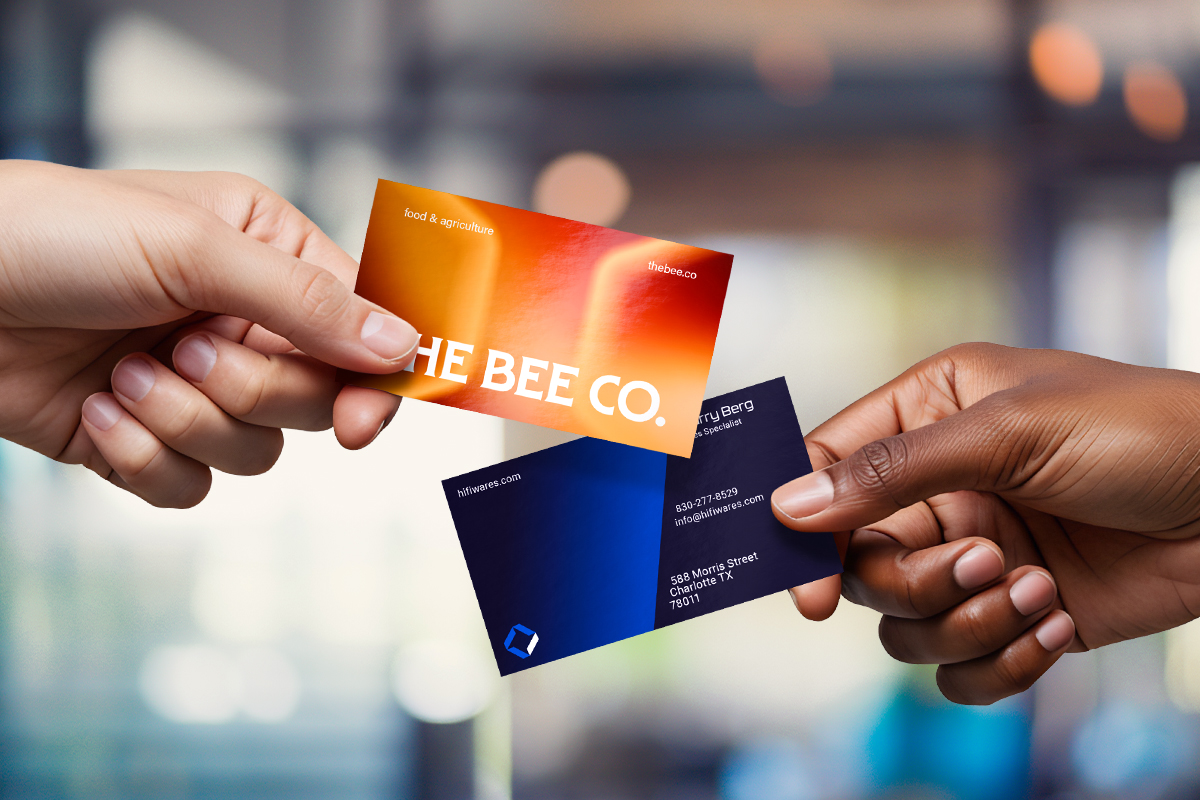
Cardstock and finish shape both the look and the price of your cards.
Aside from the quantity, several other factors also come into play. The specifications you choose can also increase or decrease your total.
Cardstock and Thickness
Cardstock determines how your business card feels. At UPrinting, standard options include 14 pt., 16 pt., and 17 pt. Each stock offers different finishes and potential upgrades.
| Cardstock | General Feel | Finish Options | Good For |
|---|---|---|---|
| 14 pt. | Lightweight yet sturdy | Gloss, matte, high gloss, some uncoated options | Everyday business cards |
| 16 pt. | Thicker and more substantial | Gloss, matte, silk, fine grit, soft touch | A more premium feel |
| 17pt. | Thickest standard option | Uncoated | A high-end writable card |
Thicker cards usually cost more, but price isn’t the only consideration. Choose a thickness based on the impression you want to make and whether you need a writable surface or a specific finish.
Printing on One or Both Sides
Double-sided printing often costs more than single-sided, since you’re adding another printed surface. Front-only printing works well when you only need basic contact information and branding. Double-sided printing gives you more room for details such as: Services- Website and social media information
- Store hours
- A QR code
- A short promotional message
Finish and Coating
The finish affects the look and feel of your business card. Common UPrinting options include:| Finish | General look or Feel | Suitable Feel |
|---|---|---|
| Gloss | Shiny and smooth | Colorful designs and photos |
| Matte | Softer, less reflective | Clean, understated designs |
| High-gloss UV | Extra shine | Designs that benefit from a glossy appearance |
| Uncoated | Natural, writable surface | Cards that may need handwritten notes |
| Silk/Soft Touch | Smooth, premium feel | Brands emphasizing tactile presentation |
| Fine Grit | Textured feel | Designs where texture is part of the presentation |
These options can raise the cost, so consider what you want the finish to accomplish. A simple gloss or matte card may be all you need for everyday networking. If you want a more distinctive physical experience, a specialty finish can add another visual element.
Size and Shape
Standard shapes and sizes fit most wallets and cardholders, making them the most practical choice. Unusual shapes or sizes can help your card stand out but may increase costs and affect usability. Consider your goals before choosing a square, slim, or custom-sized card. For a subtle change without switching shapes, consider adding rounded corners.Turnaround Time
If you have flexibility, choosing a longer turnaround time can reduce costs. Rush production is more expensive but helpful when you have upcoming events or tight deadlines.Remember, production time differs from shipping time. Use the shipping calculator to estimate delivery dates for your location.
Is It Cheaper to Order Business Cards in Bulk?

Business cards printed in bulk on a commercial sheet press, ready for cutting.
Ordering more cards often lowers the cost per card. For example, based on the table provided above, the cost drops from about $0.20 per card for 100 cards to $0.07 for 500 and $0.03 for 10,000 pieces.
However, ordering the largest quantity isn't always the best choice. If your contact details or branding are likely to change, a big order could leave you with outdated cards. While smaller orders may have a higher cost per card, they offer greater flexibility.
Choose a quantity that matches your current needs and usage. If you attend trade shows regularly or hand out cards frequently, a larger order makes sense. But if you only use a few cards each month, a smaller order is more practical.
Standard vs. Premium Business Card Costs
The type of business card you choose can make a difference in their price. Standard cards use common cardstock and finishes, while premium cards can include specialty materials, finishes, formats, or digital features that add to the cost.
| Standard Business Cards | Premium Business Cards | |
|---|---|---|
| Materials | 14 pt. or 16 pt. cardstock | Specialty cardstock, metal, and other premium materials |
| Features | Basic finishes such as gloss, matte, or uncoated | Silk, velvet, painted edges, folds, QR codes, or NFC |
| Cost | More budget-friendly | Typically costs more because of added materials and features |
| Best for | Everyday networking and regular business use | Brands that want a more distinctive or interactive card |
If you want to keep printing costs simple while providing a professional card, choose standard business cards. On the other hand, if you want to create a stronger first impression, add visual impact, texture, extra space, or functionality, spending more on a premium option may be the best choice.
How to Choose the Right Business Card Options
To control your budget effectively, start by identifying your business card needs before considering upgrades. Use these steps to streamline your decision-making:
- Define the purpose. Consider where you’ll use your cards and what action you want recipients to take after receiving them. This will help you determine which features are worth the investment.
- Set your budget. Decide how much you’re comfortable spending overall. A clear budget makes it easier to prioritize options and skip unnecessary extras.
- Prioritize what is important. If presentation matters most, you may want to put more of your budget toward the card’s material or finish. If keeping costs low is the priority, focus on the essentials.
- Review your choices. Before placing your order, make sure your selected options complement each other and that you aren’t paying for features you don’t need.
Try adjusting one option at a time and compare the results. This helps you see which factors affect the price most and lets you allocate your budget more effectively.
Sample Business Card Buying Scenarios
The right business card order depends on how often you use your cards, what you want them to accomplish, and how much you're comfortable spending. Here are a few common situations to help you choose:
| If you need to... | Recommended Approach |
|---|---|
| Keep costs low | Standard size, 14 pt. cardstock, and basic printing |
| Print cards for everyday use | A standard cardstock card with the information you use most |
| Hand out cards frequently | A larger quantity to reduce the cost per card |
| Give cards that have a thicker feel | Choose 16 pt. or 17 pt. cardstock |
| Try a new design | A smaller quantity until you're sure you'll keep the design |
| Make a stronger first impression | A premium material or finish that supports your brand, such as silk, spot UV, or foil |
| Include more information | Front-and-back or folded cards |
| Write on the card | Consider an uncoated cardstock option |
| Connect people to digital content | Choose QR code or NFC cards |
| Prepare for an event | Order early enough to avoid paying more for a faster turnaround |
How to Estimate Your Total Business Card Cost
For a precise business card estimate, enter your specifications into UPrinting’s Standard Business Card calculator.
Start with these details:
- Select your desired quantity.
- Choose your preferred card size.
- Decide on front-only or front-and-back printing.
- Pick your cardstock type.
- Choose between standard or rounded corners.
- Add any specialty finishes or bundling options.
- Select your preferred production time.
- Review the total price before finalizing your order.
Try adjusting one option at a time and compare the results. This helps you see which factors affect the price most and lets you allocate your budget more effectively.
Get the Right Cards at the Right Price
The cost of business cards is influenced by more than just quantity. Cardstock type, printing method, finish, size, corner style, and turnaround time all play a role in determining the final price.
To stay within budget, start with a standard size and cardstock, then adjust based on how you'll actually use your cards. Choose a quantity that fits your real needs, a stock that matches your goals, and add finishes only where they offer clear value.
Ready to print your business cards? Order print marketing materials from UPrinting today. For the most accurate pricing, use our product calculator to compare different quantities and options.
frequently asked questions
A.
According to UPrinting’s standard business card product page, 100 business cards cost $20.48, or about $0.20 per card. This price applies to 2" x 3.5" cards with standard corners, front-and-back printing, 14 pt. glossy cardstock, and a 3-business-day turnaround.
A.
For 1,000 business cards with the same specifications, the price is $51.99, or about $0.05 per card.
A.
Yes. Printing on both sides usually costs more, as it requires printing on an additional surface. However, double-sided cards offer extra space for contact information, services, QR codes, and other important details.
A.
Yes, they usually do. UPrinting offers 14 pt., 16 pt., and 17 pt. cardstock, giving you options for the thickness and feel of your cards.
A.
Shipping is separate from production time. The delivery date and shipping cost depend on the shipping method and destination you select during checkout.
A.
Faster production times typically cost more than standard turnarounds. UPrinting offers 1-, 2-, and 3-business-day production options for standard business cards. Keep in mind that production time does not include shipping time.
Related Articles
The Value of Premium Business Cards: Are They Worth the Cost?
Standard Business Card Sizes: The Essential First Step in Business Card Design
Digital vs. Physical Business Cards: Which is Better for You?
How to Design a Business Card That People Never Throw Away
10 Key Elements of Business Cards for Designers and Creatives