Small businesses are under real pressure heading into 2026. Firms with fewer than 10 employees shed 292,000 jobs in 2025, nearly 4.5 times what they lost during the pandemic, according to a May 2026 report from the Joint Economic Committee. The NFIB Small Business Optimism Index just dropped below its 52-year average for the first time since April 2025.
Every owner is making the same calculation: what to do with the marketing budget. A new survey of 1,000 U.S. small business professionals from UPrinting found that Baby Boomer owners are cutting their marketing budgets at nearly five times the rate of Gen Z owners, while Gen Z is increasing theirs at one of the highest rates in the survey. Two generations facing the same economic pressure are reaching for completely opposite playbooks.
That generational split is one of several patterns the data exposes. Some marketing reflexes are nearly universal across demographics, while others diverge sharply by gender, ethnicity, and business role. Together they reveal a small business marketing playbook being rewritten in real time.
Key Findings
- 30.7% of Baby Boomer owners cut their marketing budgets in 2026, compared to just 6.5% of Gen Z.
- 55.2% of Black owners and 52.6% of Hispanic owners increased marketing spend, versus 38.2% of White owners.
- 52.5% of owners say their marketing has looked cheap and they suspect it cost them customers. Among postgraduate-educated owners, 42.5% say they're certain it did.
- 33% say designing their own marketing materials is their scrappiest cost-cut
- 42.9% of women small business owners trade time for marketing budget by doing everything themselves, compared to 36.6% of men. Among Baby Boomer respondents overall, that figure climbs to 56.4%.
- 37.6% of owners say wasting money with no return is their biggest 2026 marketing fear. Among Baby Boomers, that fear hits 56.4%, the highest of any group surveyed.
- 49.1% of Founders prioritize speed when choosing a marketing tool. Just 22.7% of Owners share that priority; their top concern is the lowest cost.
Boomers Are Retreating While Gen Z Doubles Down
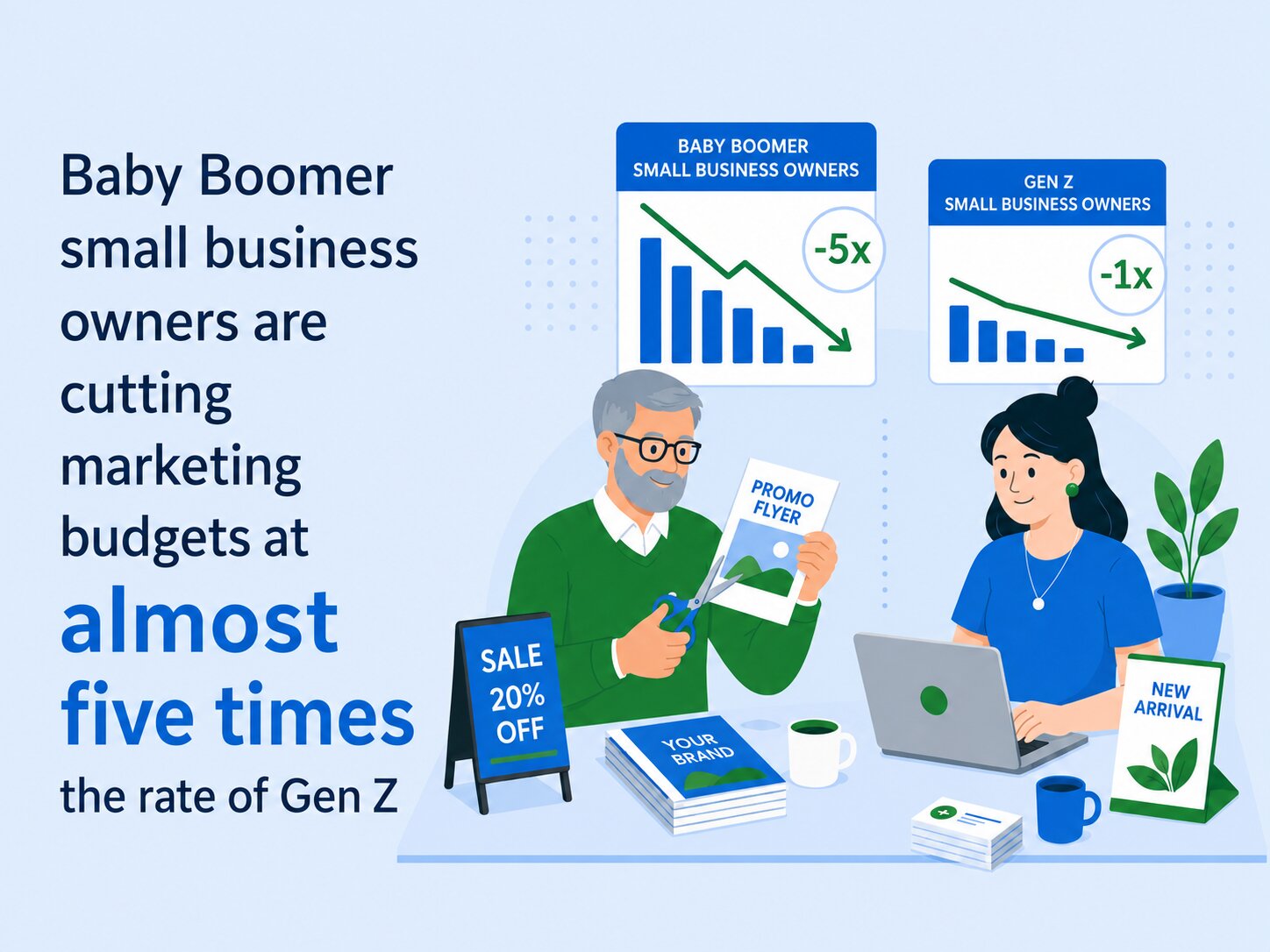
baby boomer small business owners are cutting marketing budgets nearly 5× faster than gen z
The most striking number in the entire survey is a ratio. Baby Boomer small business owners are cutting marketing budgets at almost five times the rate of Gen Z. The pattern looks less like ordinary caution and more like a strategic retreat happening at the moment their youngest competitors are pressing the gas pedal.
The fear data tells us why. Boomers' biggest 2026 marketing fear, by a wide margin, is wasting money on something that doesn't return. Gen Z's biggest fear is falling behind better-funded competitors. Same economic pressure, opposite anxieties. Boomers who've weathered three recessions tend to treat marketing as the first expense to cut when revenue gets shaky. Younger owners, many of whom are launching new businesses in 2026, see invisibility as the bigger risk.
Every Generation Cuts Differently, But They All Protect Email
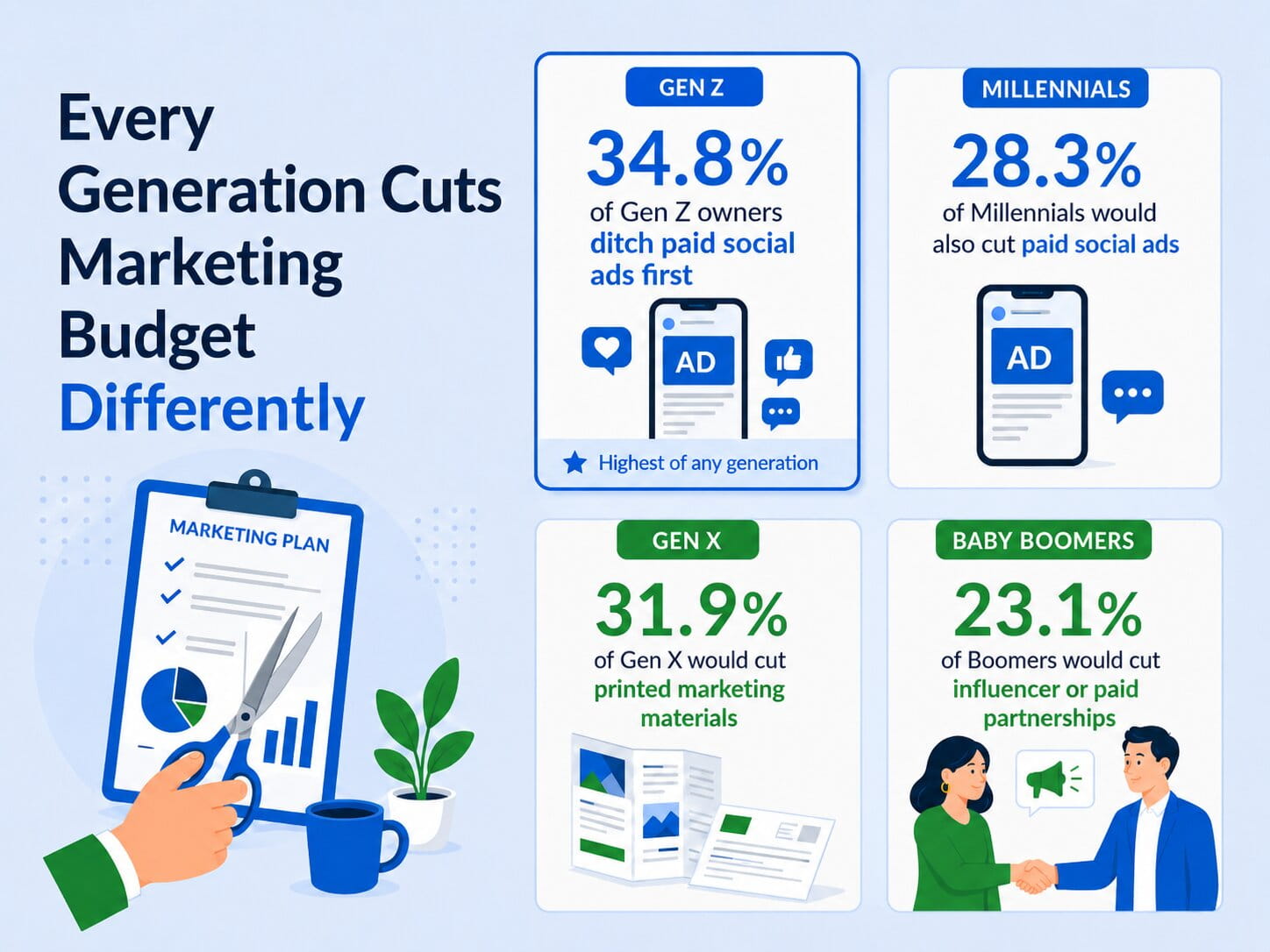
every generation cuts marketing budget differently
When budgets tighten, every generation reaches for a different scalpel.
- 34.8% of Gen Z owners ditch paid social ads first, the highest of any generation.
- 28.3% of Millennials would also cut paid social ads.
- 31.9% of Gen X would cut printed marketing materials.
- 23.1% of Boomers would cut influencer or paid partnerships.
The pattern isn't about what each generation values most. It's about what each generation feels least attached to keeping. Gen Z and Millennials have lived inside paid social long enough to watch the returns erode, the CPMs climb, and the algorithm changes punish small advertisers. Their willingness to cut it first reflects experience, not indifference. They know exactly what they're walking away from.
What every generation refuses to cut tells the more important story. Across every age group in the survey, email is the channel owners protect most fiercely when budgets tighten. Boomers protect it. Gen X protects it. Millennials protect it. Gen Z protects it. In a marketing landscape where every other channel is contested across generations, email stands alone as the one line item nobody is willing to lose.
Black and Hispanic Owners Are Building a Quiet Lead
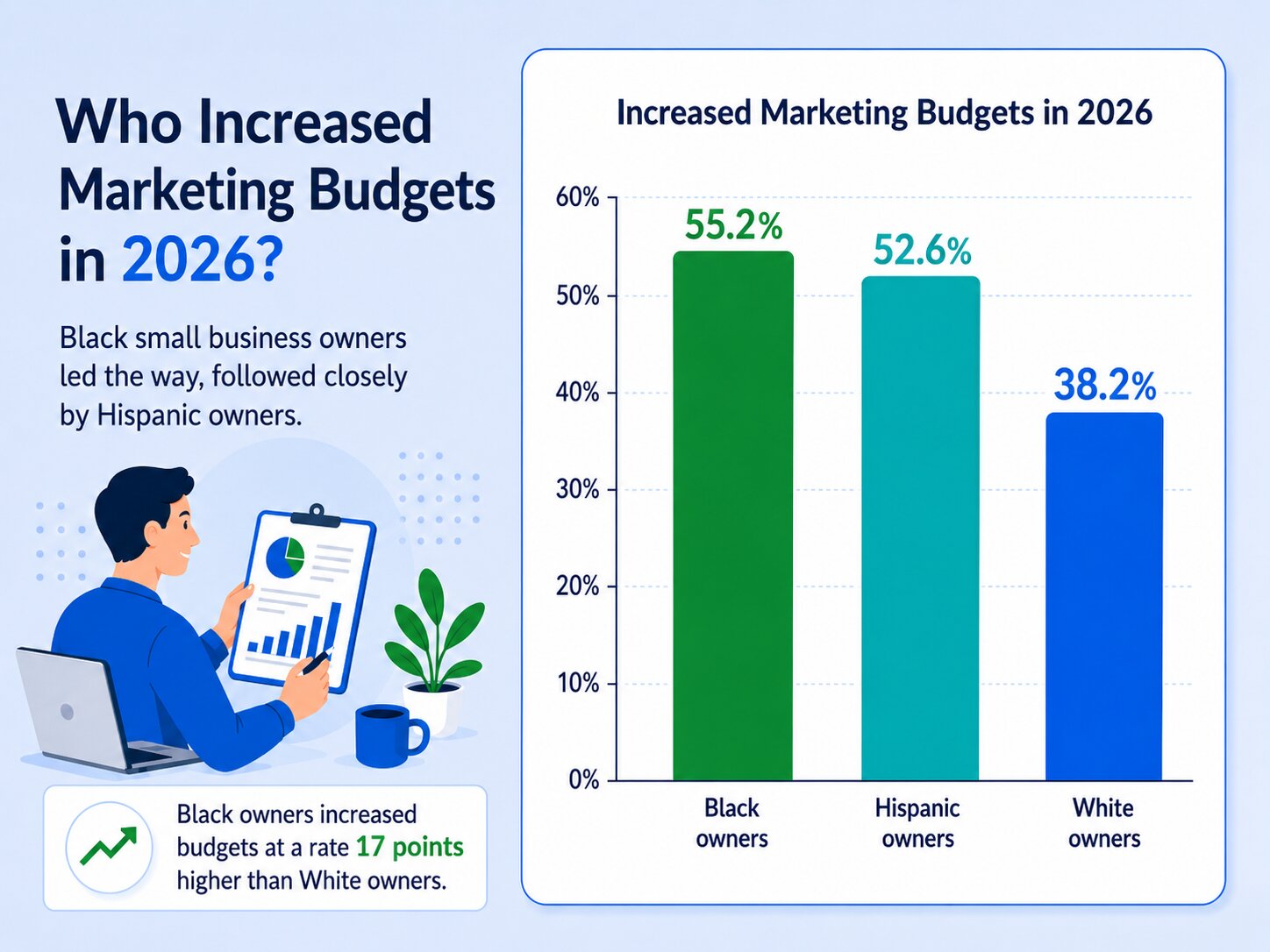
black small business owners led the way, followed closely by hispanic owners
White small business owners increased marketing budgets at a rate of 38.2% in 2026. Among Black owners, the figure was 55.2%, a 17-point gap. Among Hispanic owners, 52.6%.
The investment gap shows up against a backdrop of well-documented financial pressure. The Federal Reserve's 2026 Small Business Credit Survey found two specific challenges minority-owned firms cite at higher rates: difficulty reaching new customers and increasing sales, and lagging technology adoption. Those two pressures together help explain why marketing investment matters so much to these owners. When access to capital is tighter and reaching new customers is harder, visibility becomes one of the highest-leverage growth tools available.
The aggressive marketing spend among Black and Hispanic owners reads as a direct response to those structural pressures. Played out over five years, that pattern doesn't just shift individual fortunes. It changes whose businesses customers think of first.
The DIY Move Everyone Loves
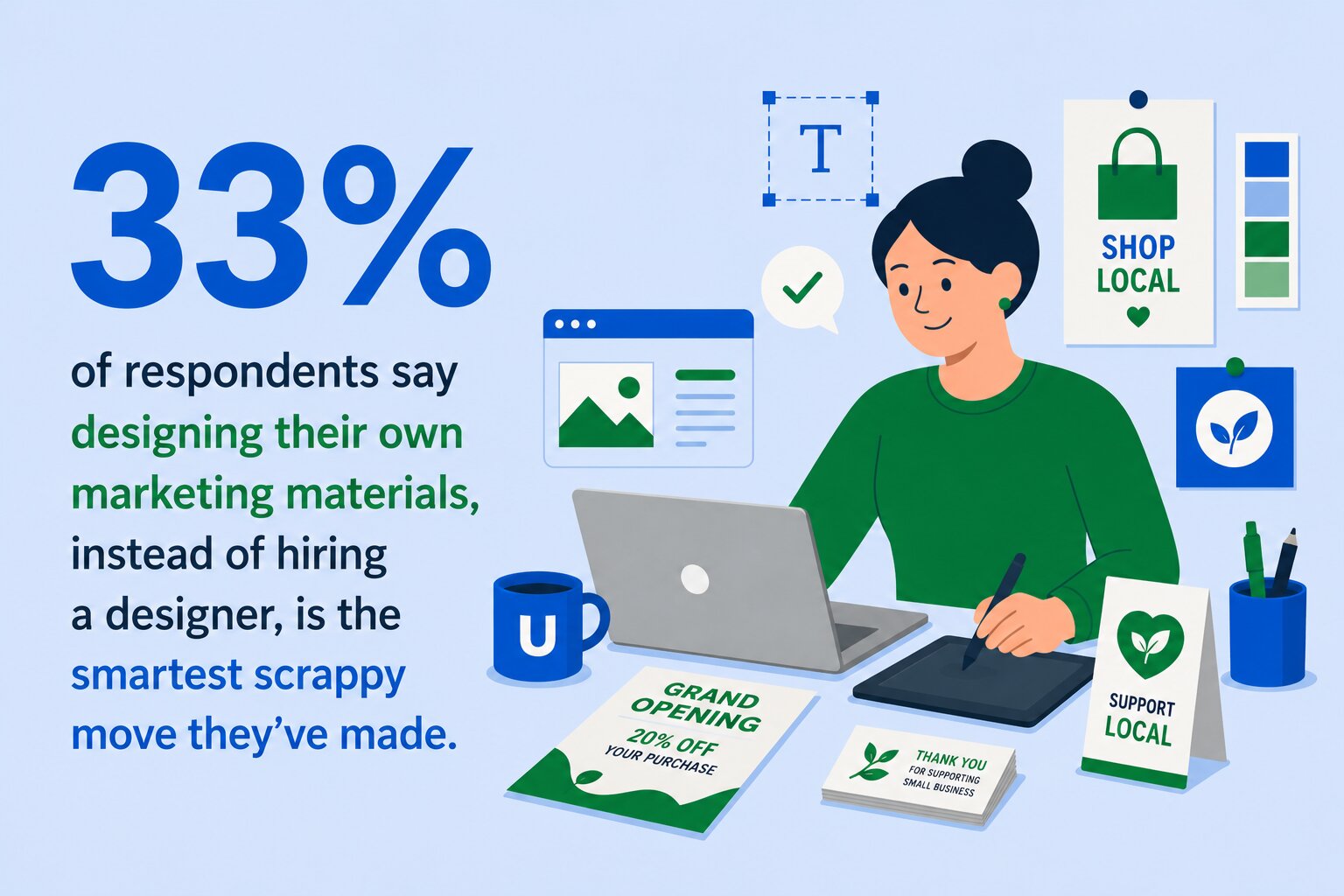
33% of respondents say they design their own marketing materials
A contradiction sits at the heart of the 2026 small business mindset. A third of respondents say designing their own marketing materials from flyers, postcards, stickers, posters, and packaging instead of hiring a designer, is the smartest scrappy move they’ve made.
That answer holds across nearly every demographic the survey measured. The only exceptions were Asian-owned businesses, Operations business roles, and owners with less than a high school degree.
The exceptions are interesting in their own right. Each of those groups landed on a different cost-cut: switching to a cheaper vendor or reusing existing creative. Both moves protect the one thing DIY design tends to sacrifice (visual quality) while still trimming cost. The groups breaking from the consensus may have stumbled onto a smarter version of scrappy.
A separate finding in the same survey suggests the DIY consensus may be coming with a hidden cost. 52.5% of small business owners say their marketing has, at some point, looked cheap enough that they suspect it cost them customers. Among postgraduate-educated owners, 42.5% say they're certain of it. It’s a reminder that everyday materials like business cards and vinyl banner still shape first impressions.
The survey doesn't directly link cheap-looking marketing to DIY design work, but the pattern is hard to miss: most owners cut corners by designing their own materials, and most owners also worry that their marketing has looked cheap. Whether those two findings overlap in the same owners is a question worth asking.
Women Are Paying for Marketing With Their Time, Not Their Wallet
When budgets tighten, the dominant small-business reflex is to take on the marketing workload personally rather than spend money on it. That answer holds across nearly every demographic the survey measured. Trading time for money is the de facto survival tactic for small-business marketing in 2026.
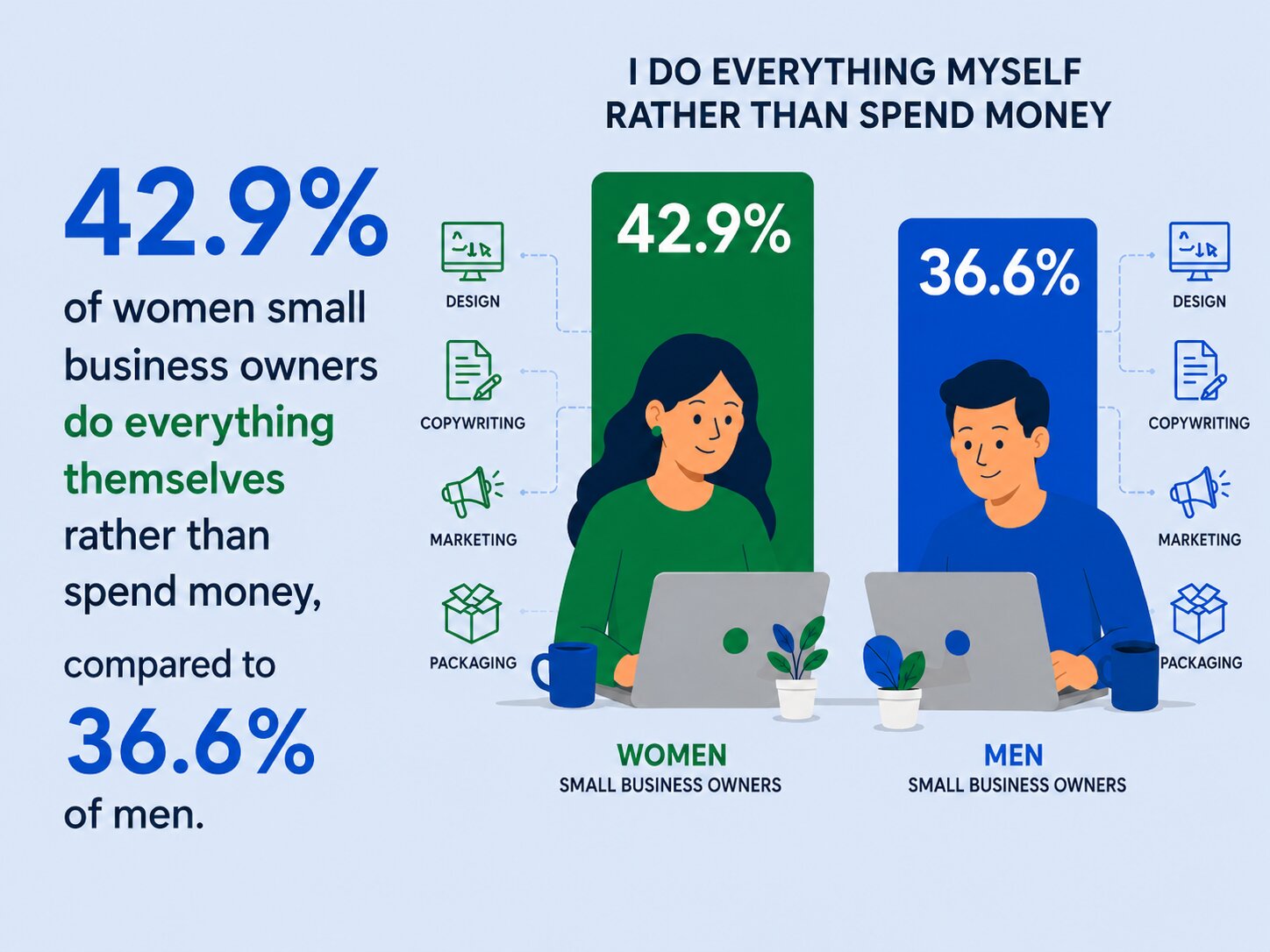
42.9% of women small business owners do their marketing materials
But the burden isn't shared equally. 42.9% of women small business owners do everything themselves rather than spend money, compared to 36.6% of men. Baby Boomer respondents overall absorb the brunt at 56.4%, the highest of any demographic group.
There's also a starting-line problem. Just 32.6% of women in the survey increased their 2026 marketing budgets, compared to 50.3% of men, a 17-point divergence on what may be the most consequential financial decision a small business makes each year.
Whether the cause is risk tolerance, access to capital, or business type, women-led small businesses are entering 2026 in a more cautious posture and absorbing more of the workload to make up for it.
Everyone Wants Fast Marketing Results, But Most Budgets Aren't Growing to Match
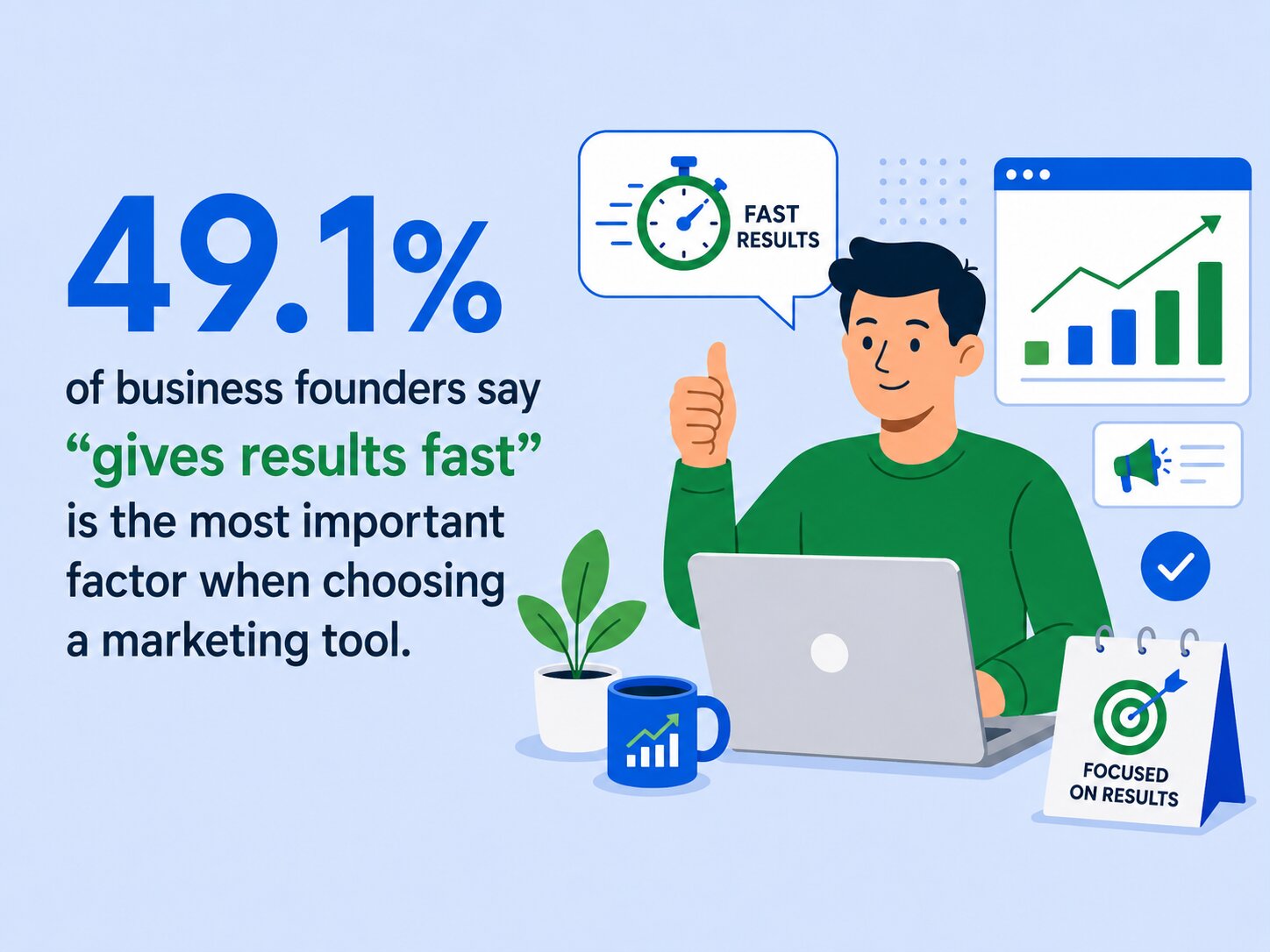
49.1 percent of business founders say "gives results fast" is the most important factor when choosing a tool
One of the more surprising patterns in the survey is how differently small business roles think about what makes a marketing tool worth using. Nearly half of founders, 49.1%, say "gives results fast" is the most important factor when choosing a marketing tool. Everyone else across nearly every business role in the survey agrees.
The exceptions are owners and admins. Owners prioritize lowest cost while admins want easy setup. In a small business culture racing toward faster campaign turnaround, two of the most operationally embedded roles are still optimizing for the budget line, not the deadline.
Despite the demand for faster results, many budgets aren’t growing to match. 57.6% of respondents reported that their marketing budget either stayed flat or decreased in 2026 so far. Owners are reaching for tools that promise speed in a year when most of them haven't expanded the budget that would let them buy it.
What's Actually Working in 2026: Free Channels That Reward Consistency
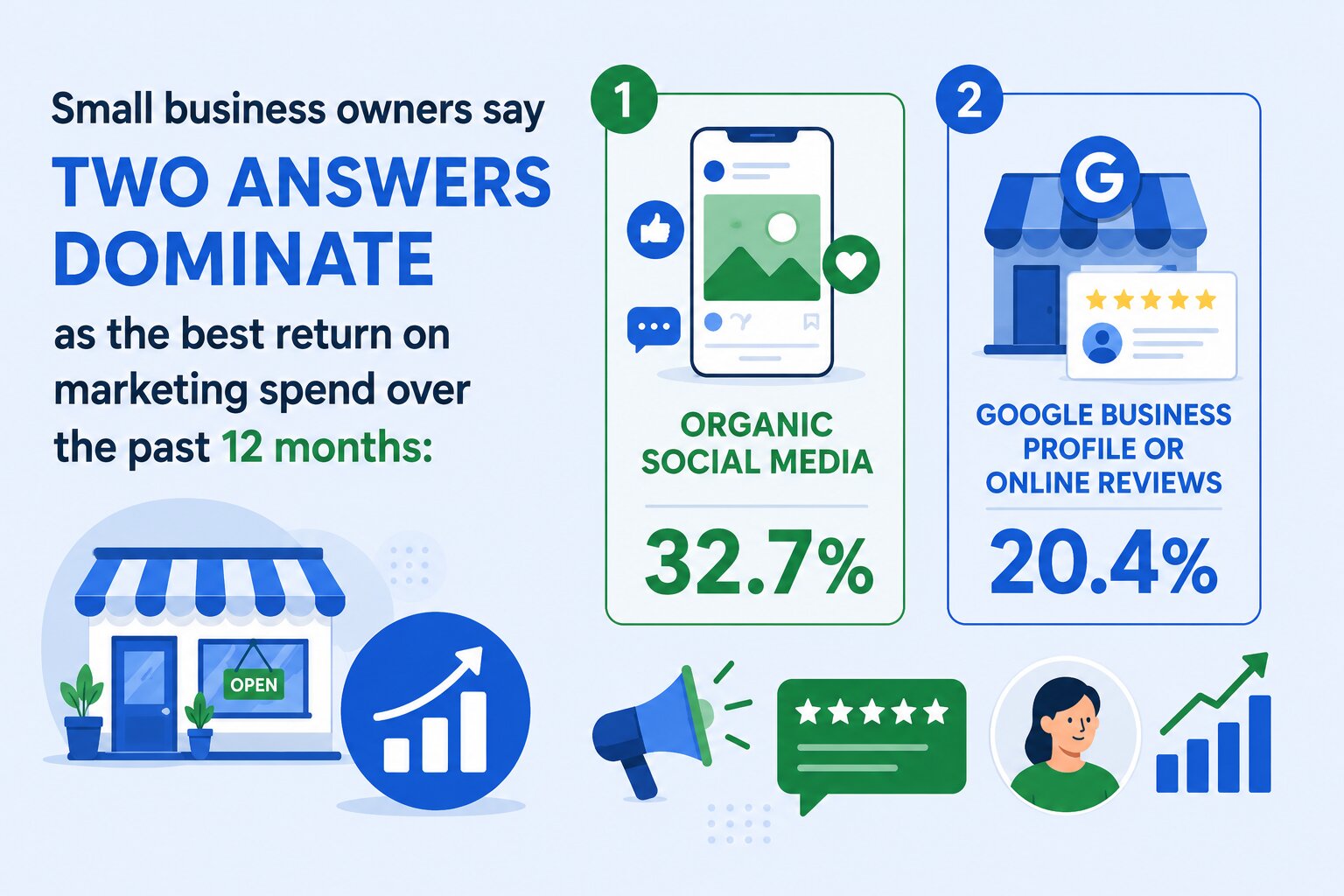
organic social media, google business profile, or online reviews have the best return on marketing spend
When you ask small business owners what actually delivered the best return on marketing spend over the past 12 months, two answers dominate: organic social media (32.7%) and Google Business Profile or online reviews (20.4%).
Both channels cost nothing. Part of the reason free channels look so good in 2026 is that paid ads have gotten genuinely expensive. The price of running an ad on platforms like Facebook and Instagram has climbed steadily over the past several years, while the visibility each ad earns has dropped.
That math has pushed more small businesses toward channels they can work for free. Among Asian-owned businesses, Google Business Profile leads at 34.1%, the highest of any named ethnic group. Among Gen Z owners, organic social hits 43.5%.
The takeaway in the data is straightforward. Paid channels still work, but the businesses winning in 2026 figured out which free channels their customers actually use, and they invested their time there. For businesses trying to stay visible beyond digital channels, postcards and mailing services can play a similar role offline, keeping a brand in front of nearby customers without requiring a large campaign budget.
The Packaging Signal Gen Z Is Sending
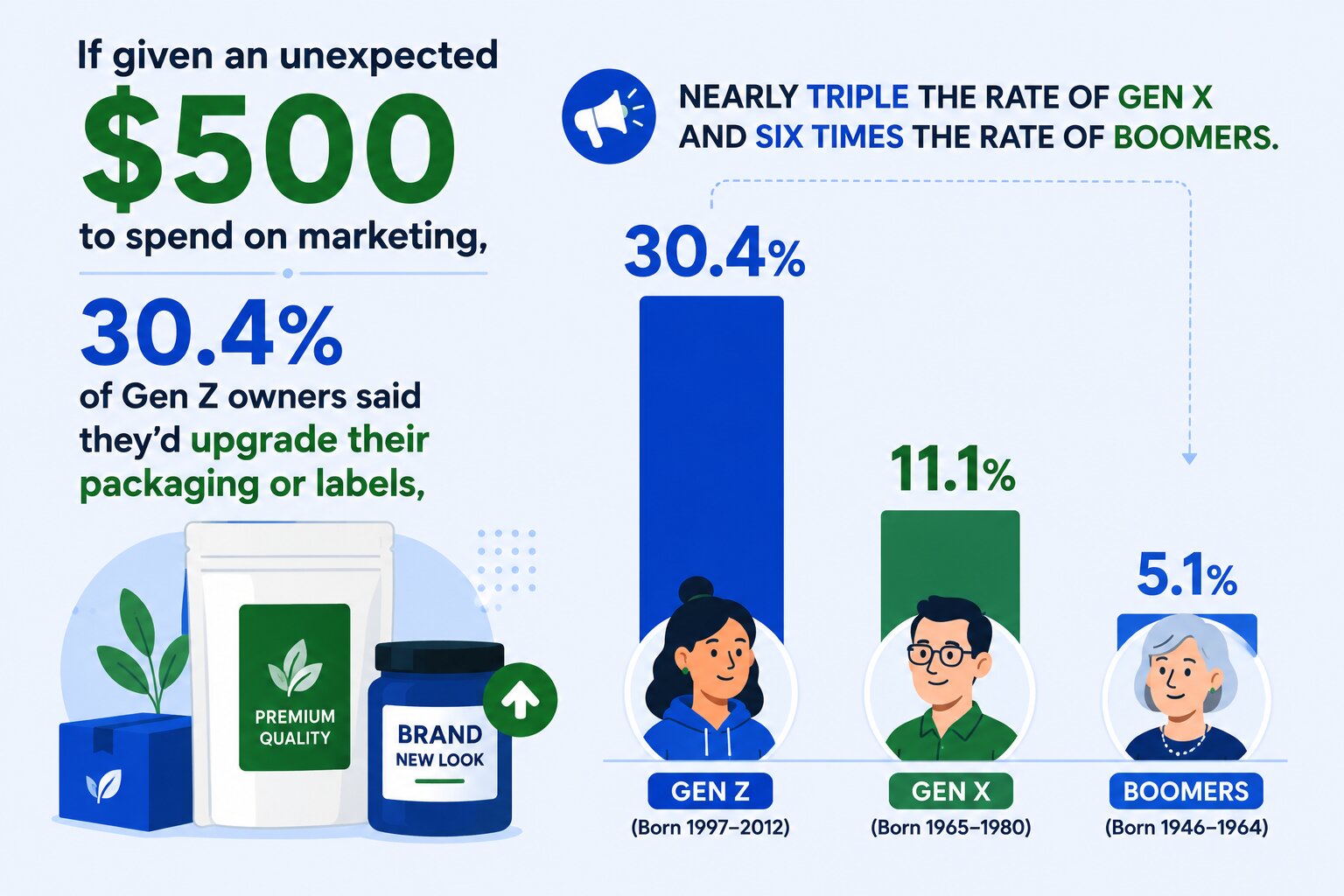
30.4% of gen z owners said they upgrade their packaging or labels
If given an unexpected $500 to spend on marketing, 30.4% of Gen Z owners said they'd upgrade their packaging or labels, nearly triple the rate of Gen X (11.1%) and six times the rate of Boomers (5.1%).
The instinct makes sense in a world where unboxing videos drive product discovery and a customer's first physical interaction with a brand is often a shipping label. Gen Z grew up filming themselves and watching strangers do the same with products they loved. They understand intuitively that packaging functions as content, not just container, and that a custom box or label can earn the kind of organic attention a paid ad can't buy. Older owners still see packaging as overhead. Younger ones see it as media.
Summary
The story underneath the numbers is about how the same economic pressure is producing very different responses, and how those responses are likely to determine whose business is still standing in 2028.
Owners pulling back to protect what they have aren't wrong to be cautious. Owners pressing forward to claim attention aren't wrong to be aggressive. Both instincts are reasonable answers to the same hard question: how do you market your way through a year when every dollar feels like it might be your last? The survey suggests the answer depends less on the size of the budget than on what the owner believes the budget is for. Survival or growth. Holding the line or moving it.
Small businesses still drive 51 percent of total net job creation in this country, according to the Bureau of Labor Statistics. The decisions millions of owners are making about their marketing this year are not small ones. They will shape what Main Street looks like in 2027.
Methodology
To understand how Americans approach small business marketing in 2026, UPrinting surveyed 1,000 adults across the country via Pollfish who work in or own small businesses. Participants answered a series of questions about their marketing budgets, channel performance, cost-cutting strategies, biggest fears, and the tradeoffs they make when resources are tight. Responses were analyzed by demographic groups, including age, gender, income, ethnicity, education, and business role, to identify trends and disparities.
Fair Use Policy
Users are welcome to utilize the insights and findings from this study for noncommercial purposes, such as academic research, educational presentations, and personal reference. When referencing or citing this article, please ensure proper attribution to maintain the integrity of the research. Direct linking to this article is permissible, and access to the original source of information is encouraged.
For commercial use or publication purposes, including but not limited to media outlets, websites, and promotional materials, please contact the authors for permission and licensing details. We appreciate your respect for intellectual property rights and adherence to ethical citation practices. Thank you for your interest in our research.