The lowest price on custom packaging doesn't matter much if you order the wrong amount. Order too little and you risk stockouts, rushed production, and expensive shipping. Order too much and you tie up cash, fill valuable storage space, and could end up with outdated packaging if your branding or products change.
The good news is that you don't need a complicated forecasting model to make smarter decisions. By considering a few key factors like your expected sales, minimum order quantities (MOQs), lead times, storage capacity, and budget, you can place packaging orders with greater confidence.
How Do You Figure Out the Right Packaging Order Quantity?
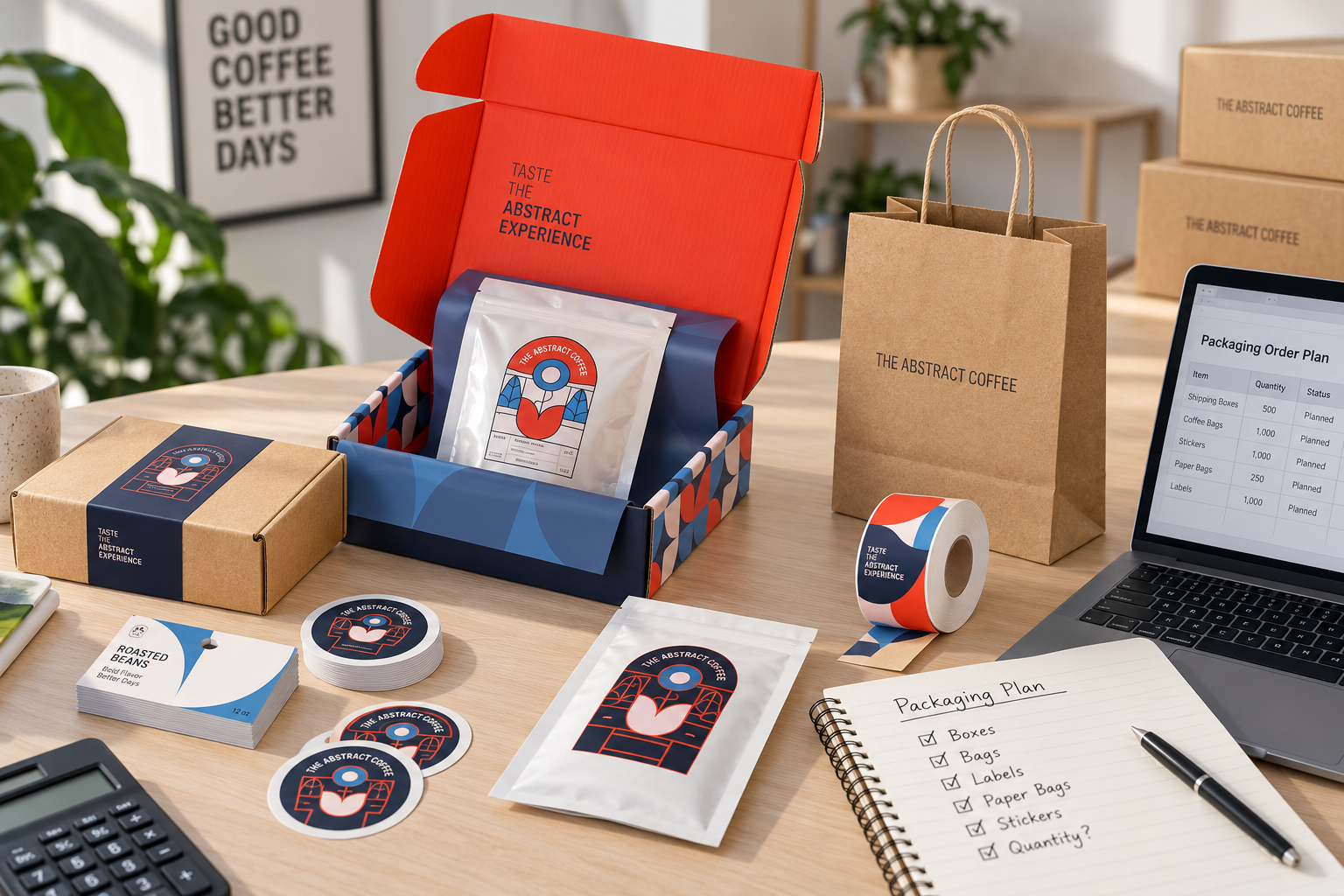
Custom printed packaging for a coffee brand
There's no universal formula that works for every business. The ideal order quantity depends on how quickly you sell, how your supplier manufactures packaging, and how much inventory your business can comfortably manage.
When deciding how much packaging to order, consider these five factors:
- Expected sales volume: How many orders do you anticipate before your next packaging purchase?
- Minimum order quantity (MOQ): Does your supplier require a minimum order size?
- Lead time: How long will production and shipping take?
- Storage capacity: Do you have room to safely store extra packaging?
- Cash flow and budget: Can your business comfortably invest in a larger order today?
Start With Your Expected Sales
Your sales volume should be the foundation of every packaging order. While you don't need perfect forecasts, having a reasonable estimate helps prevent both shortages and excess inventory.
Estimate How Many Units You'll Actually Need
Look at your recent sales history and identify patterns. If your business has been growing steadily, account for that growth rather than relying solely on last month's numbers. You should also consider upcoming promotions, product launches, holiday campaigns, or wholesale opportunities that could increase demand.
If you're a new business without historical data, start conservatively and plan to reorder more frequently as you learn your sales patterns.
Don't Forget Extra Packaging
Your packaging needs won't always match your order count exactly. It's smart to keep a small buffer for situations like:
- Damaged or misprinted packaging
- Replacement shipments
- Product photography and samples
- Unexpected spikes in demand
- Production or shipping delays
A little extra inventory can help you avoid scrambling when something doesn't go according to plan.
Understanding Minimum Order Quantities (MOQ)
Even if you’ve calculated the ideal order quantity, your supplier’s minimum order quantity may affect what you can purchase. However, over the past 5 to 10 years, many common packaging options have become available with lower MOQ requirements. If a supplier’s minimum is too high, consider finding another supplier or exploring alternative packaging formats that better match your needs.
Why MOQ Often Determines Your First Order
A minimum order quantity (MOQ) is the smallest number of units a manufacturer can produce in a single order. MOQs help offset setup costs and make production more efficient, especially for custom packaging.
For many businesses (particularly those ordering custom boxes for the first time), the MOQ becomes the practical starting point.
Should You Order More Than the Minimum?
Sometimes it makes sense to order more than the MOQ. Larger orders often reduce the cost per unit, which can provide better long-term value.
However, lower unit pricing shouldn't be the only consideration. Before increasing your order size, ask yourself:
- Can you comfortably store the extra packaging?
- Will your branding or packaging design stay the same for several months?
- Does your cash flow allow for a larger upfront purchase?
If the answer to any of these is "no," sticking closer to the minimum order may be the better decision.
Balance Unit Cost Against Storage and Cash Flow
Buying in bulk often lowers your cost per piece, but the cheapest unit price isn't always the most economical choice.
Bigger Orders Aren't Always Better
Large packaging orders require more storage space and tie up capital that could be invested elsewhere in your business. They also increase the risk of having unused inventory if your products, branding, or packaging requirements change.
Instead of focusing solely on savings per unit, think about the total cost of owning that inventory.
Balancing Tips
A few simple guidelines can help:
- Order enough to cover the next several months—not years.
- Avoid buying more simply because the unit price drops slightly.
- Leave room in your budget for unexpected business expenses.
- Consider how quickly you can reorder if demand increases.
The goal is to strike a balance between efficiency and flexibility.
Plan Around Production and Shipping Lead Times

One of the biggest planning mistakes is waiting until you're nearly out of packaging before placing your next order.
Custom packaging often requires time for production, printing, quality checks, and shipping. During busy seasons, these timelines may become even longer.
Rather than reordering when your shelves are empty, plan ahead so your next shipment arrives before you need it. Building a small buffer into your schedule can help protect your business from unexpected production or shipping delays.
Plan for Seasonal Demand
Sales rarely stay consistent throughout the year.
Many businesses experience predictable spikes during holidays, promotional events, back-to-school season, or major product launches. If you only order based on your average monthly sales, you may run short when demand increases.
For example:
- An online gift shop may need significantly more packaging before the holiday season.
- A beverage company might order additional packaging before launching a limited-edition flavor.
- An ecommerce business could see higher order volumes during Black Friday or Cyber Monday promotions.
You don't need perfect forecasts. Just account for known busy periods and build a reasonable buffer into your planning.
How Packaging Planning Changes as Your Business Grows
Your ordering strategy will naturally evolve as your business matures.
Early-Stage Businesses
New and growing businesses often benefit from smaller, more frequent orders. While the unit cost may be slightly higher, this approach reduces inventory risk and gives you flexibility if your products or branding change.
Growing Businesses
As sales become more predictable, businesses can usually plan further ahead. Larger orders may offer better pricing, simplify purchasing, and reduce the frequency of reorders, provided storage space and cash flow support the investment.
When It's Worth Asking Your Packaging Supplier
You don't have to figure everything out on your own.
An experienced packaging supplier can help you choose an order quantity based on your expected sales, production schedule, and business goals.
Consider asking for guidance if:
- You're placing your first custom packaging order.
- You're unsure how many units you'll need.
- You're planning for a seasonal sales increase.
- You're comparing different quantity breaks.
- You're building a recurring ordering schedule.
Sharing your expected sales volume and reorder timeline can help your supplier recommend a quantity that fits your business instead of simply selling you the largest order available.
Packaging Order Planning Checklist
Before placing your next packaging order, ask yourself:
A few minutes of planning today can help you avoid running out of stock, carrying unnecessary inventory, and placing last-minute rush orders later.
frequently asked questions
A.
Order enough packaging to cover your expected sales until your next planned reorder, while considering your supplier's MOQ, lead times, available storage space, and budget. Most businesses aim to balance inventory availability with cash flow rather than simply buying the largest quantity possible.
A.
A minimum order quantity (MOQ) is the smallest number of units a manufacturer will produce in a single order. Custom packaging often has MOQs because production setup costs remain relatively fixed regardless of order size.
A.
It depends. Larger orders usually reduce the cost per unit, but they also require more storage space and tie up more capital. The best order size is one your business can comfortably store and afford.
A.
Plan your order early enough to account for production and shipping lead times, plus a buffer for unexpected delays. Avoid waiting until you're almost out of packaging before placing your next order.
A.
Yes. Keeping a small surplus helps cover damaged packaging, replacement shipments, quality control issues, and unexpected increases in demand.
A.
Review your sales patterns from previous busy seasons and increase your order quantity before demand rises. Planning ahead can help you avoid stockouts during peak sales periods.
A.
Yes. If you're unsure how much to order, many packaging suppliers can recommend an order quantity based on your expected sales, lead times, and production requirements.