New to winemaking? Learn the TTB label rules every winery must follow, from brand name to ABV, to ensure your wine is legal and ready to sell.
This lists all TTB’s mandatory requirements for wine labels to help you avoid common labeling errors.
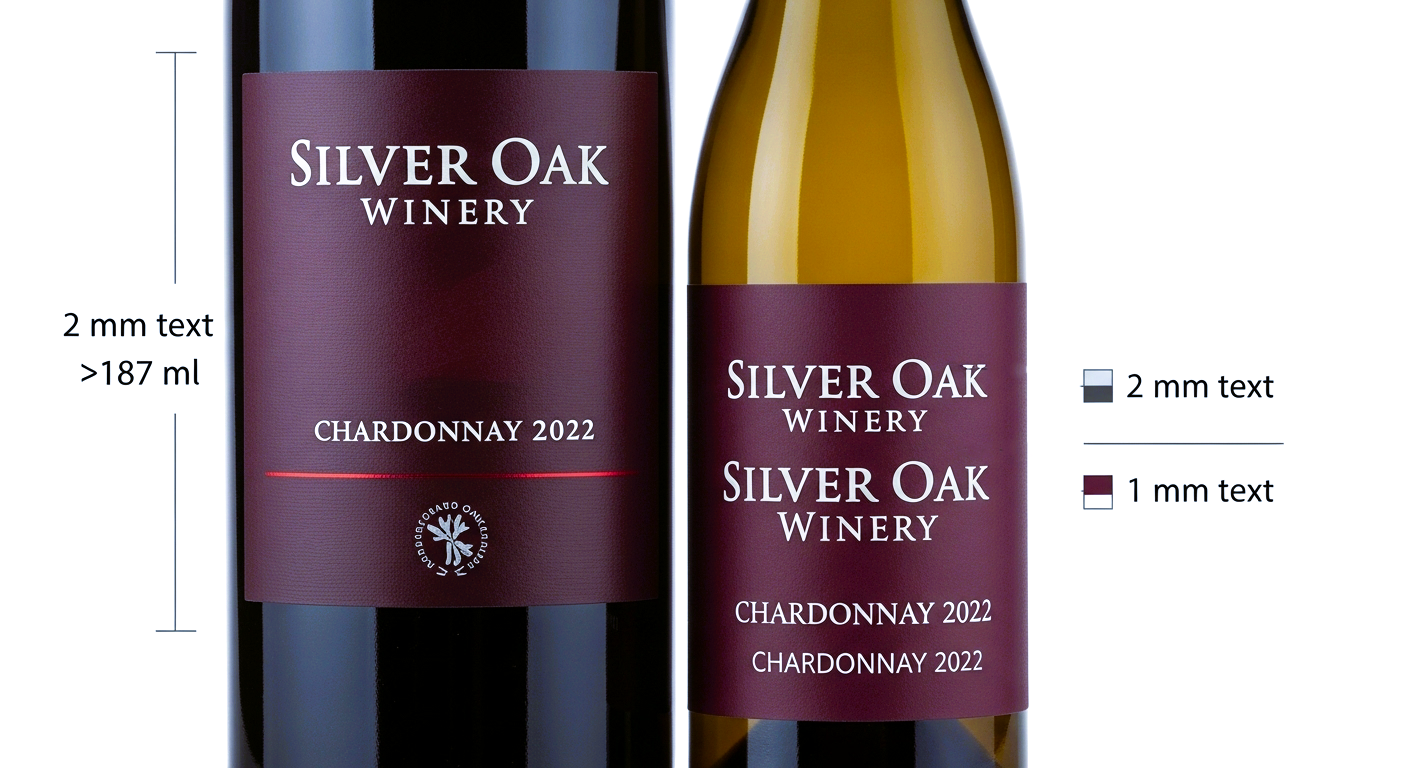
Wine bottle labels with winery branding and typography design
The brand name, also known as producer identification, is typically the name of the winery or winemaker. But in the absence of a brand name, TTB requires the use of the wine producer’s name.
Every wine label should have a brand name, which is often the most prominent information on it.
Optional: Some wine producers add a “sell name,” which is a descriptive word or phrase used to further identify their products. The TTB mandates that it should not create a false or misleading impression about a wine product.
Formatting Requirements:
Examples of Sell Names:
Rose Wine, Amber Wine, Sunset Rose, and Scarlet Wine
This information pertains to the type of wine. Common examples include “Peach Wine,” “Red Wine,” “Sparkling Wine,” “Merlot,” “Table Wine,” and “Chardonnay.”
If a bottled wine uses multiple grape varieties (or wine blends), the TTB stipulates that companies must specify the percentage of each grape, which should total 100%.
Example:
This red wine is a blend of 60% CABERNET SAUVIGNON and 40% MERLOT.
Formatting Requirements:
Example:
50% American wine / 50% French wine
The Appellation of Origin pertains to the area where the grape (or any agricultural product) used to make the wine was grown. It can be a country, state, county, or American Viticultural Area (AVA), which is a designated wine grape-growing region in the United States.
Some wine producers add the “Vintage Date” (e.g., 2022) above the Appellation of Origin. This optional information pertains to the year when the grapes were harvested.
Formatting Requirements:
Example:
Napa Valley and Red Mountain (AVA)
California and Colorado (States)
The alcohol content by volume (ABV) of a bottled wine may appear as a specific number or range. All wine products with over 14% ABV are required to have this information on their labels.
However, wine products with 7-14% ABV may choose not to include this information if the Class or Type Designation on the label says “Table Wine” or “Light Wine.
Formatting Requirements:
Example:
Alcohol __% by volume
This information pertains to the volume of wine in a container and is typically measured in milliliters (ml) and liters (L).
Check out the Code of Federal Regulations’ list of authorized metric standards of fill for wine.
Formatting Requirements:
Example:
1.5 L, 3 L, 300 ml, and 700 ml
This information pertains to the city and state listed on your business permit. It is typically preceded by phrases like “Bottled by,” “Packed by,” “Vinted by”, “Produced by”, “Blended by,” and “Made by.”
Some wine products may require more information beyond the Name and Address. For example, a wine brand produced at one location and bottled at another must state two different locations on its label.
Any alcoholic beverage with an alcohol content of 0.5% or higher that is for sale or distribution must have Health Warning Statements.
Formatting Requirements:
Examples:
GOVERNMENT WARNING: (1) ACCORDING TO THE SURGEON GENERAL, WOMEN SHOULD NOT DRINK ALCOHOLIC BEVERAGES DURING PREGNANCY BECAUSE OF THE RISK OF BIRTH DEFECTS. (2) CONSUMPTION OF ALCOHOLIC BEVERAGES IMPAIRS YOUR ABILITY TO DRIVE A CAR OR OPERATE MACHINERY, AND MAY CAUSE HEALTH PROBLEMS.
A wine label should have a Sulfite Declaration (e.g., “Contains Sulfites or “Contains a Sulfating Agent”) if the total sulfur dioxide or a sulfating agent is detected at a level of 10 or more parts per million (ppm).
If your wine does not contain sulfites or the level is below 10 ppm, the Sulfite Declaration is not required. However, you have to submit a lab analysis to the TTB together with your COLA application to prove your claim.
You may use the phrase “No sulfites added” on your wine label as long as it appears together with a “Contains naturally occurring sulfites” statement.
Once your COLA application has been approved, you can start bottling your wine (make sure you pick the authorized metric standards of fill) and print your wine labels.
The right material for your wine labels depends on where the bottles will be stored. For products that will be primarily stored and displayed indoors, white paper is a suitable option, while those that will be refrigerated are best suited for BOPP-made labels.
BOPP is a refrigerator-safe, waterproof, tearproof, and oil-resistant material, making it a popular choice among wine producers and bottlers.