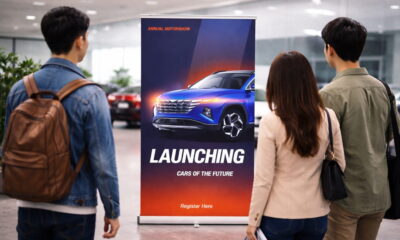
Two of the most popular options are retractable banners and pop-up displays. While both are designed to increase visibility and reinforce branding, they serve very different purposes.
- Retractable banners are compact, portable, and easy to deploy. They work well when you need a professional display that travels easily and takes up minimal floor space.
- Pop-up displays are larger exhibit systems that create a branded backdrop, making them ideal for trade shows, conventions, and events where visibility is a priority.
Choosing the right display can make a significant difference in how people notice and remember your brand at an event. Whether you're exhibiting at a trade show, promoting a sale in-store, or setting up at a community fair, your display needs to attract attention while fitting your space, budget, and setup requirements.
In this guide, we'll compare retractable banners and pop-up displays side by side, examine their strengths and limitations, and help you choose the option that delivers the most value for your event strategy.
Key Takeaways
- Retractable banners are lightweight, portable displays designed for quick setup and smaller spaces.
- Pop-up displays create a larger visual presence and work best as trade show backdrops and exhibit displays.
- Businesses that travel frequently often prefer retractable banners because they are easier to transport and store.
- Pop-up displays offer significantly more space for branding, graphics, and messaging.
- Both display types are reusable and customizable for recurring events and promotions.
- The best choice depends on your booth size, event goals, budget, and desired level of visibility.
Retractable Banner vs. Pop-up Display: Quick Comparison
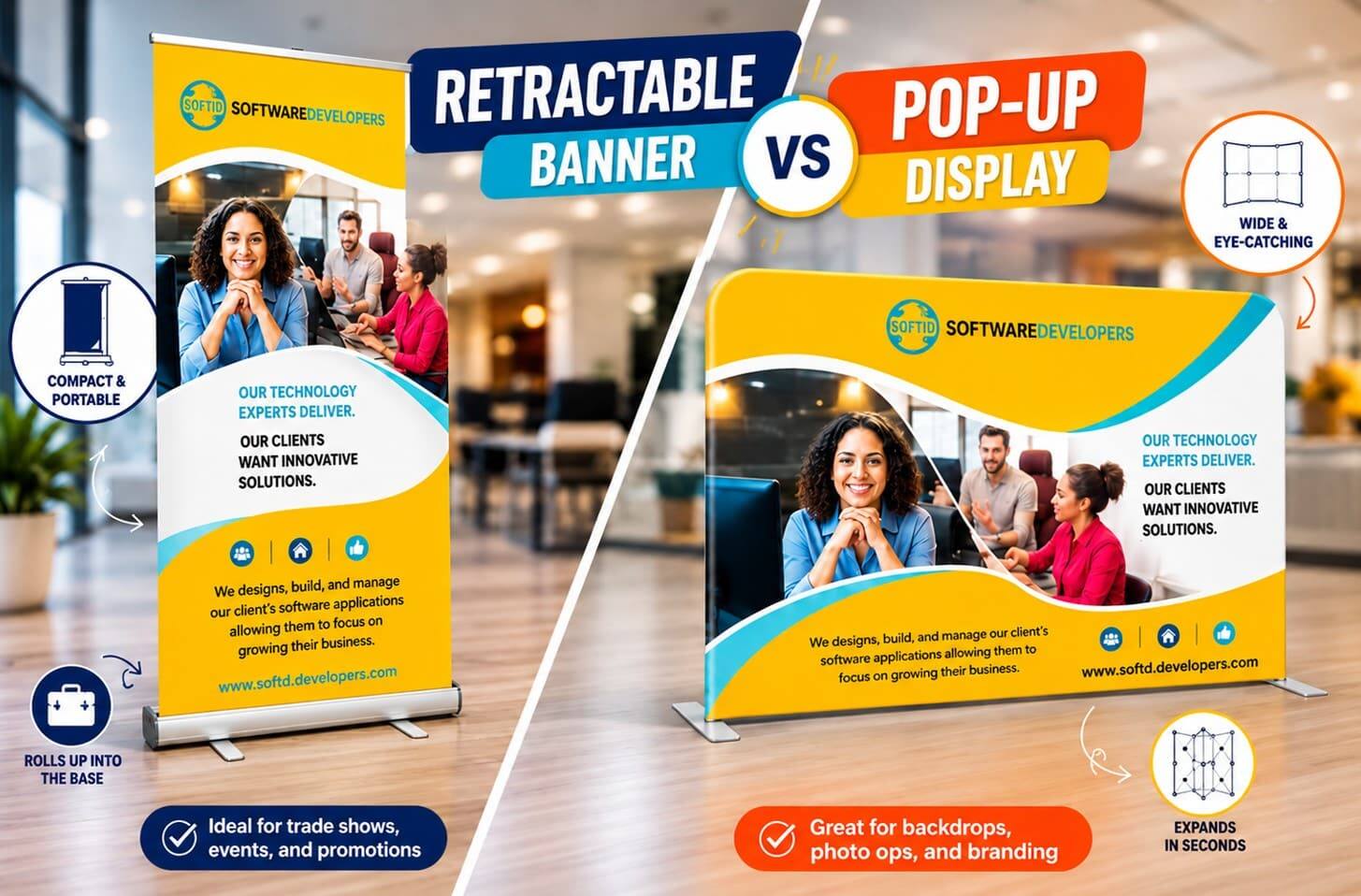
Comparison of retractable and pop-up banners.
The primary difference between retractable banners and pop-up displays comes down to portability versus presence.
- A retractable banner functions as a standalone promotional sign. It occupies very little space, can be assembled in minutes, and is easy to carry between events.
- A pop-up display acts as a large-format backdrop designed to create a more immersive brand experience and attract attention from across an event floor.
| Feature | Retractable Banner | Pop-up Display |
|---|---|---|
| Best For | Retail promotions, entrances, presentations, small booths | Trade shows, conventions, exhibit booths, branded backdrops |
| Visual Impact | Moderate | High |
| Branding Space | Limited | Extensive |
| Portability | Excellent | Good |
| Setup Time | Typically 1–2 minutes | Typically 10–30 minutes |
| Storage | Compact | Requires larger storage case |
| Travel Convenience | Easy to transport | Bulkier but manageable |
| Cost | Lower upfront investment | Higher upfront investment |
| Booth Presence | Supports a display | Defines a display |
| Ideal Venue Size | Small to medium spaces | Medium to large event spaces |
The Biggest Difference: Portability vs. Presence
Before comparing sizes, graphics, or setup times, it helps to understand the fundamental purpose of each display.
- Retractable banners are designed for convenience. They allow businesses to create a professional presence without investing in a large exhibit system. Because the banner retracts into its base, transportation, storage, and setup require very little effort.
If your priority is mobility, simplicity, and affordability, a retractable banner is often the better choice.
- Pop-up displays are designed for visibility. Their larger footprint helps establish a branded environment that can be recognized from across a crowded venue. Instead of serving as a supporting display, they often become the focal point of an entire booth. If your priority is attracting attention, reinforcing your brand, and creating a stronger booth presence, a pop-up display will usually deliver better results.
Choose a Retractable Banner If You:
- Attend multiple events throughout the year
- Need a display that travels easily
- Have limited booth space
- Want a lower-cost display solution
- Need fast setup and takedown
- Primarily promote one message or offer at a time
Choose a Pop-up Display If You:
- Exhibit at major trade shows or conventions
- Need a full booth backdrop
- Want maximum visual impact
- Have a larger event footprint
- Need more room for graphics and branding
- Want a polished, exhibit-style presentation
When a Retractable Banner Is the Better Choice
Not every event demands a full exhibit. In many cases, a retractable banner delivers all the visibility a business needs and takes a fraction of the effort to transport, set up, and reuse. For companies that attend multiple events a year, that ease of use compounds into a real advantage. A retractable banner fits naturally into a 6-foot table setup or compact booth, adding professional branding without crowding the space. Most exhibitors place one behind or beside their table to show their logo, value proposition, and contact details, leaving the surface free for samples, materials, and conversations.
Retail Promotions and Store Displays
Retail stores frequently use retractable banners to promote seasonal sales, new product launches, loyalty programs, and limited-time offers.
Because banners can be moved easily, businesses can reposition them throughout the store as promotions change without replacing permanent signage.
Job Fairs and Recruiting Events
Recruiting teams often need portable displays that can be transported between campuses, career fairs, and hiring events.
A retractable banner allows recruiters to showcase company culture, open positions, and employer branding while maintaining a professional appearance.
Businesses That Travel Frequently
For companies that attend multiple conferences, expos, networking events, and community gatherings each year, portability becomes a major consideration.
Retractable banners pack into a compact carrying case and fit easily into most vehicles, making them one of the most convenient event display solutions available.
What Is a Retractable Banner?
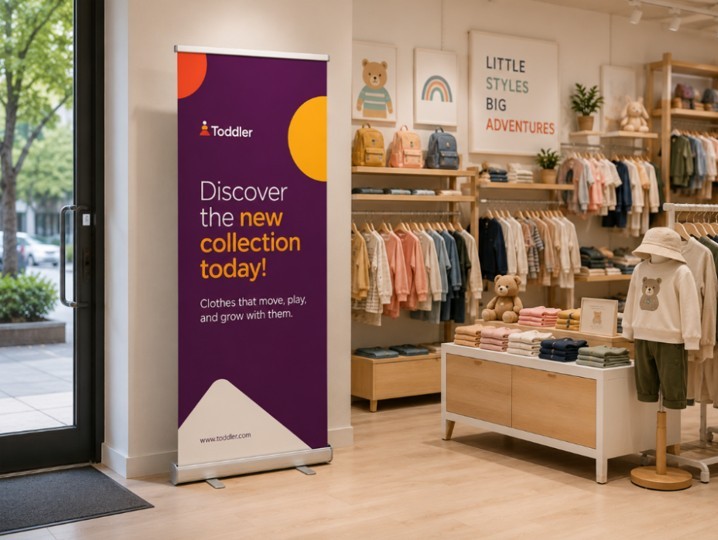
Retractable banner display inside clothing store.
A retractable banner is a portable display system that stores a printed graphic inside a protective base. During setup, the banner is pulled upward and secured with a support pole, creating a freestanding display in just a few minutes.
When the event ends, the graphic retracts back into the base, helping protect it from damage during transportation and storage.
This simple design is one reason retractable banners have become a staple marketing tool across industries.
Common uses include:
- Trade shows
- Retail promotions
- Conferences
- Corporate lobbies
- Product launches
- School events
- Real estate presentations
- Community outreach events
Their versatility makes them a practical choice for businesses that need a display capable of performing in multiple environments.
Common Retractable Banner Sizes
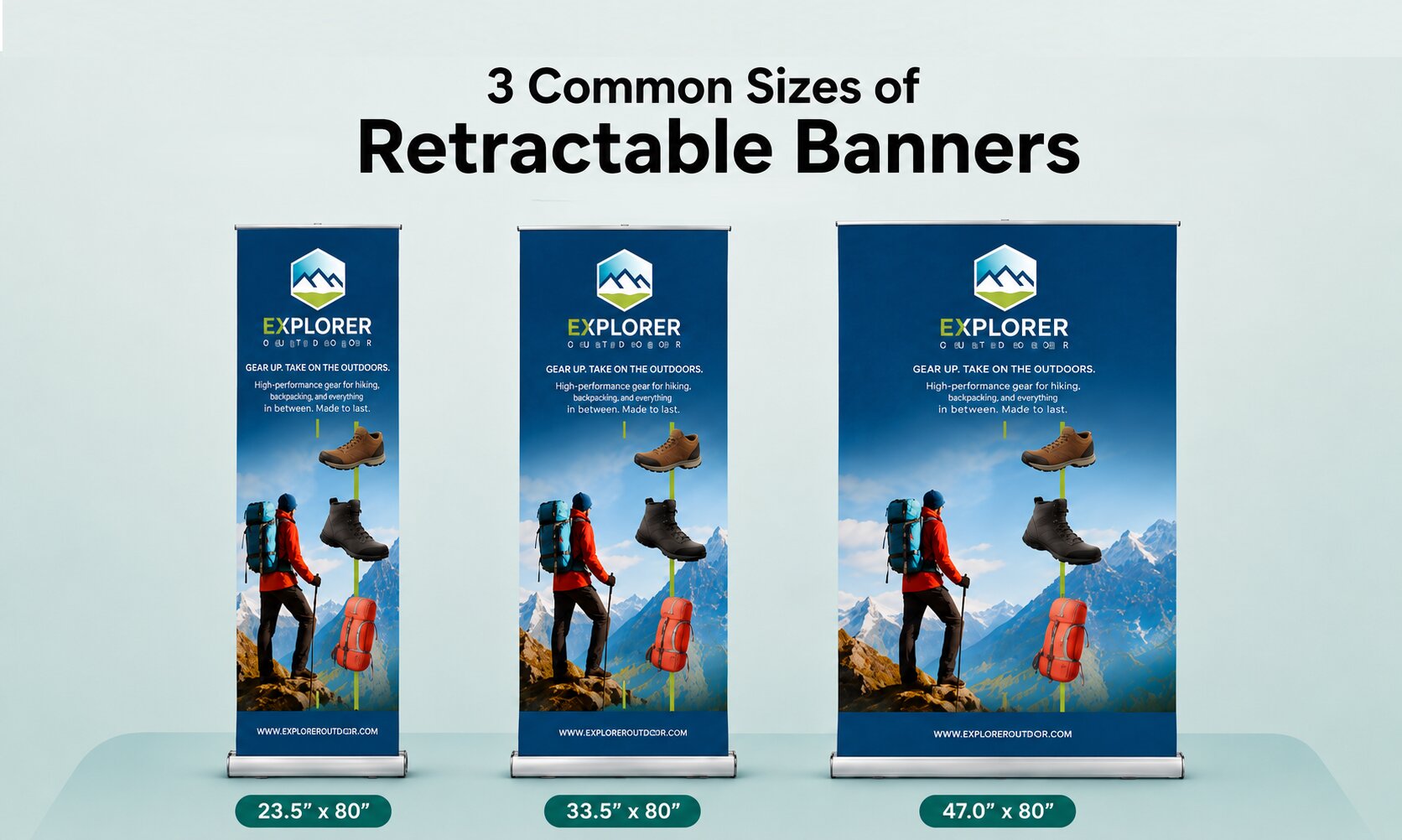
Retractable banner sizes
The most common retractable banner sizes include:
- 23.5" x 80"
- 33.5" x 80"
- 47" x 80"
The 33.5" x 80" format is often considered the most versatile option because it balances portability with visibility.
Smaller banners work well in tight spaces where every square foot matters, while wider formats provide additional room for product imagery, promotional messaging, and branding elements.
When selecting a size, consider both your available floor space and how far away viewers will typically be standing.
How to Design an Effective Retractable Banner
A retractable banner isn't meant to function like a brochure. Most attendees will only glance at it for a few seconds, which means clarity matters more than detail.
Focus on One Message
The most effective banners communicate a single idea.
Whether you're promoting a service, introducing a product, or advertising a special offer, avoid trying to fit multiple campaigns onto one display.
A focused message is easier to understand and easier to remember.
Design for Quick Scanning
Most people encounter event signage while walking past.
Your design should allow viewers to understand who you are and what you offer within a few seconds.
Use:
- Short headlines
- Concise supporting copy
- Strong visual hierarchy
- Minimal clutter
Use Large, Readable Typography
If attendees can't read your headline from a distance, the display loses much of its effectiveness.
Prioritize large fonts, strong contrast, and simple typography that remains legible across the venue.
End With a Clear Call-to-Action
Every banner should tell viewers what to do next.
Examples include:
- Visit Our Booth
- Scan the QR Code
- Book a Free Consultation
- Learn More Online
- Request a Quote
A clear call-to-action helps convert attention into engagement.
Setup, Storage, and Portability
One of the biggest advantages of retractable banners is how quickly they can be deployed.
Most setups involve:
- Positioning the banner base
- Assembling the support pole
- Pulling the graphic upward
- Securing the banner to the pole
The entire process usually takes just a few minutes and requires no special tools.
When the event is over, the banner retracts into its base for protection and can be stored in a carrying case until the next use.
For businesses that prioritize convenience and efficiency, few display products offer the same combination of portability, durability, and ease of use.
When a Pop-up Display Is the Better Choice
While retractable banners excel at portability, pop-up displays are built for visibility.
If your goal is to attract attention across a crowded event floor, create a more professional exhibit space, or establish a stronger brand presence, a pop-up display can make a significant difference.
Because they provide substantially more graphic real estate, pop-up displays allow businesses to tell a larger visual story and create a booth environment that feels intentional and memorable.
Trade Shows and Industry Conventions
Trade shows are often highly competitive environments where attendees are surrounded by dozens, if not hundreds, of exhibitors.
A larger backdrop helps your booth stand out from a distance and makes it easier for attendees to identify your brand before they reach your space.
For businesses investing in premium booth locations, sponsorships, and event marketing, a pop-up display often serves as the visual centerpiece of the exhibit.
Product Launches and Brand Activations
When introducing a new product or service, presentation matters.
A pop-up display provides enough space to showcase large product imagery, campaign messaging, and supporting visuals without feeling cluttered.
The result is a more immersive experience that helps reinforce the launch message.
Media Events and Photo Opportunities
Many companies use pop-up displays as branded backdrops for press conferences, interviews, speaking engagements, and photo opportunities.
Because the display occupies a large visual area, it helps ensure brand visibility in event photography, social media content, and promotional coverage.
Larger Booth Spaces
The larger your booth footprint, the more important visual balance becomes.
A single retractable banner can look undersized in a 10' x 10' or 10' x 20' booth. A pop-up display helps anchor the space and creates a stronger visual foundation for the rest of your event materials.
What Is a Pop-up Display?
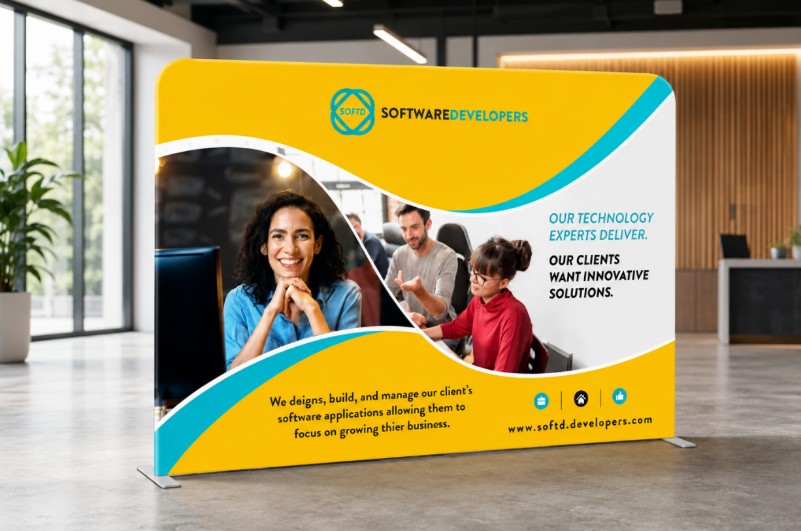
Large pop-up backdrop banner display.
While retractable banners excel at portability, pop-up displays are built for visibility. If your goal is to attract attention across a crowded floor, create a more professional exhibit space, or establish a stronger brand presence, a pop-up display can make a significant difference. With substantially more graphic real estate, they let businesses tell a larger visual story and create a booth that feels intentional and memorable.
Businesses commonly use pop-up displays for:
- Trade show booths
- Convention exhibits
- Corporate events
- Product launches
- Press conferences
- Speaking engagements
- Photo backdrops
- Brand activations
Because of their larger size, pop-up displays often become the focal point of an event space.
Common Pop-up Display Sizes
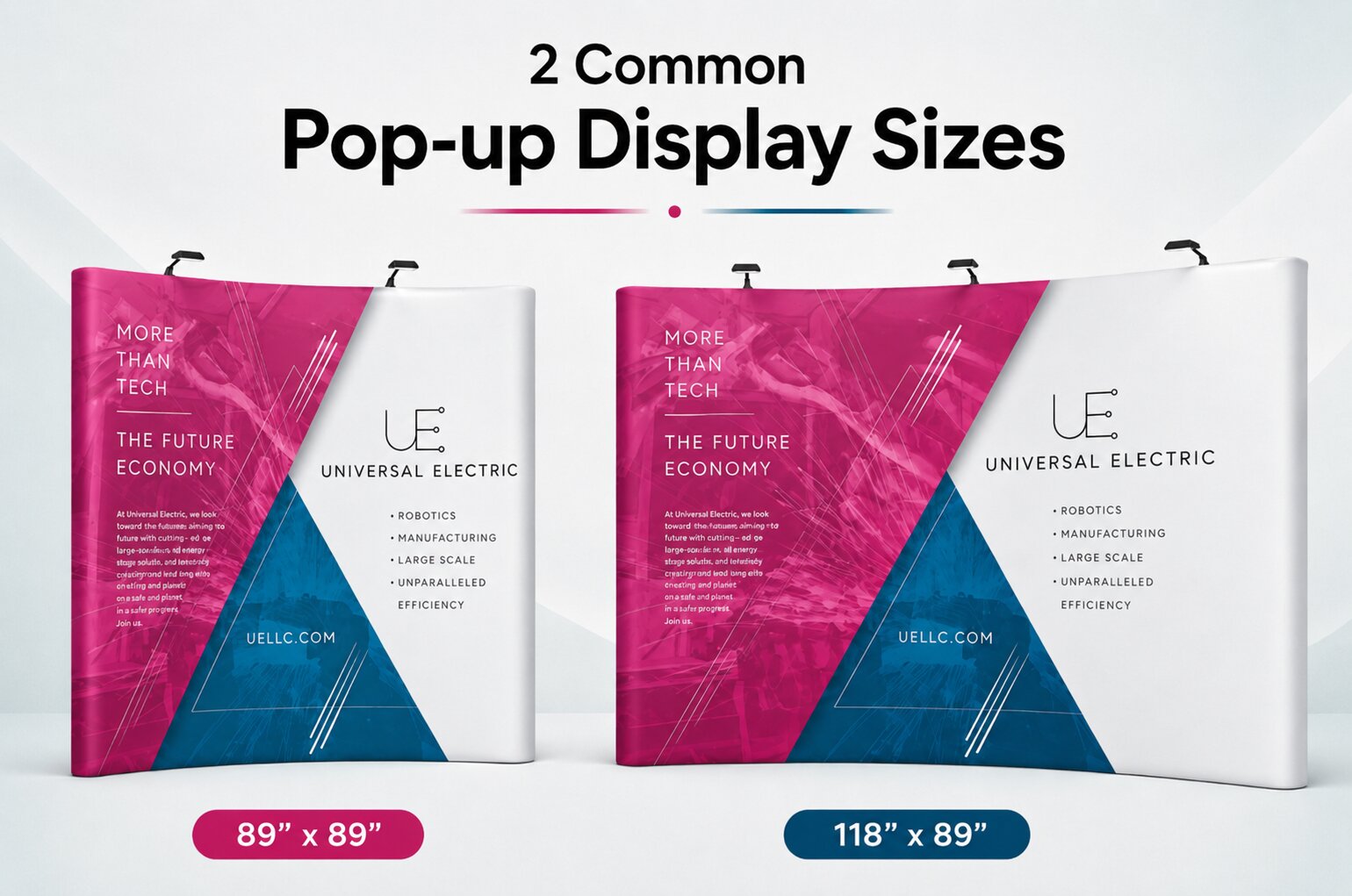
Pop up display sizes
Two of the most popular pop-up display sizes include:
- 89" x 89"
- 118" x 89"
An 89" x 89" display is often a strong fit for standard trade show booths and smaller exhibit spaces.
A 118" x 89" display provides additional width for larger graphics, broader messaging, and increased visibility across the event floor.
The right size depends on several factors:
- Booth dimensions
- Viewing distance
- Branding requirements
- Event objectives
As a general rule, businesses exhibiting at larger conventions often benefit from the added impact of wider displays.
How to Design an Effective Pop-up Display
Designing a pop-up display requires a different mindset than designing a retractable banner.
The objective is not simply to communicate information. It's to capture attention, reinforce branding, and encourage people to approach your booth.
Lead With Visuals, Not Text
Attendees usually see your display from a distance before they can read it.
Strong photography, product imagery, and brand visuals often have a greater impact than paragraphs of text.
Your display should communicate visually first and verbally second.
Keep Messaging Simple
Having more space doesn't mean you should fill it.
Many of the best-performing exhibit displays contain:
- A logo
- One headline
- One supporting message
- One primary visual
Trying to communicate too much information often weakens the overall impact.
Design for Distance Viewing
A display that looks great on a computer screen may become difficult to read across an exhibit hall.
Use large typography, strong contrast, and simple layouts that remain effective from several feet away.
A useful test is to view the design from across a room. If key messages disappear, they likely need to be larger.
Create a Clear Focal Point
Every display should have one dominant element that attracts attention immediately.
This could be:
- A product image
- A brand logo
- A campaign message
- A lifestyle photograph
A strong focal point helps guide the viewer's attention and creates a more memorable presentation.
Consider Event Photography
Trade shows and conferences generate a significant amount of social media content.
Attendees, speakers, sponsors, and event organizers frequently take photos throughout the venue.
A clean, visually appealing backdrop can increase the likelihood that your brand appears in event photography and shared content.
Setup, Storage, and Transportation
Although pop-up displays require more assembly than retractable banners, modern systems are designed to simplify the process.
Setup typically involves:
- Expanding the collapsible frame
- Locking the structure into position
- Attaching graphics or tension fabric
- Making final alignment adjustments
Depending on the display size, setup may take anywhere from 10 to 30 minutes.
Most systems collapse into a carrying case for transportation and storage between events.
While they require more effort to move and assemble than retractable banners, the added visual impact often makes the investment worthwhile for businesses that regularly participate in trade shows and exhibitions.
Can You Use Retractable Banners and Pop-up Displays Together?
Absolutely. In fact, many exhibitors use both to create a more complete and professional booth experience.
Rather than viewing them as competing products, think of them as serving different roles within the same display strategy.
A common trade show setup includes:
- A pop-up display as the primary backdrop
- One or two retractable banners positioned on either side
- A branded table cover in front
- Printed marketing materials such as brochures, flyers, or catalogs
In this arrangement, the pop-up display establishes the overall brand presence while the retractable banners highlight specific products, promotions, or calls-to-action.
For example, a software company might use a large backdrop to showcase its brand and core value proposition, while individual banners promote product features, customer success stories, or demo sign-ups.
Combining both display types can help maximize visibility while creating a more organized and engaging booth layout.
Cost Considerations
Budget is often one of the biggest factors when choosing between event displays.
While pricing varies based on size, materials, and customization options, retractable banners generally require a lower upfront investment than pop-up displays.
However, evaluating cost alone can be misleading.
The better question is: Which display delivers the most value for your specific event strategy?
Initial Investment
Retractable banners are typically the more affordable option.
Their compact design and simpler hardware make them accessible for small businesses, startups, schools, nonprofits, and organizations with limited event budgets.
Pop-up displays require a larger investment because they include a larger frame system and significantly more printed graphic material.
Transportation Costs
Businesses that travel frequently should also consider transportation expenses.
Retractable banners are lightweight and compact, making them easier and less expensive to transport.
Pop-up displays often require larger carrying cases and may increase shipping or baggage costs when traveling to events.
Storage Requirements
Storage can become a hidden expense for businesses that maintain multiple event displays.
Retractable banners require very little space and can often be stored in closets, offices, or storage cabinets.
Pop-up displays occupy more room and may require dedicated storage areas between events.
Long-Term Value
Both display types are reusable and can provide years of service when properly maintained.
If your business attends several events each year, investing in durable display materials can significantly reduce marketing costs compared to repeatedly producing temporary signage.
The key is choosing the display that aligns with how you actually exhibit.
Which Display Delivers Better ROI?
The answer depends less on the product itself and more on how you plan to use it.
Retractable Banner ROI
Retractable banners typically deliver the strongest return when:
- You attend multiple events each year
- Booth space is limited
- Travel convenience matters
- Budget efficiency is a priority
- You need flexible signage for multiple locations
Because they are relatively inexpensive and highly portable, many businesses recover their investment quickly through repeated use.
Pop-up Display ROI
Pop-up displays often provide better value when:
- Trade shows are a major marketing channel
- Brand presentation influences purchasing decisions
- You exhibit in larger booth spaces
- Visibility is critical to attracting traffic
- You participate in high-profile events
The larger investment is often justified by increased brand exposure and a stronger presence in competitive event environments.
The Best Value May Be a Combination
For businesses that regularly exhibit at trade shows, the strongest return often comes from using both products together.
A pop-up display creates the visual foundation, while retractable banners communicate specific messages and promotions.
This layered approach creates a more polished booth experience while maximizing the strengths of each display type.
frequently asked questions
A.
Yes. Retractable banners are designed for repeated use. The graphic retracts into the base when not in use, helping protect it during storage and transportation.
A.
Retractable banners are generally easier to transport because they are lighter, more compact, and faster to pack. Pop-up displays remain portable but typically require larger carrying cases.
A.
It depends on your booth size and event goals. Retractable banners work well for smaller exhibits and straightforward promotions, while pop-up displays are better suited for creating a larger branded environment.
A.
Most pop-up displays are designed primarily for indoor environments. Wind, moisture, and uneven surfaces can affect stability unless the display is specifically manufactured for outdoor use.
A.
Many businesses pair event displays with:
- Table covers
- Brochures
- Flyers
- Business cards
- Foam boards
- Vinyl banners
- Step and repeat backdrops
Using multiple branded materials together creates a more cohesive and professional presentation.
Final Verdict: Which Display Should You Choose?
Both options can boost visibility, reinforce branding, and create a more professional event presence. The better choice depends on what you're trying to accomplish.
Choose a retractable banner if portability, affordability, and quick setup matter most. They're ideal for businesses that attend multiple events, work with limited space, or need flexible signage that travels well.
Choose a pop-up display if you want stronger visual impact and a dedicated booth presence. The added branding space pays off at trade shows, conventions, and product showcases where standing out matters.
You don't necessarily have to choose one or the other. Many businesses combine both — a pop-up display as the backdrop, retractable banners reinforcing key messages throughout the booth.