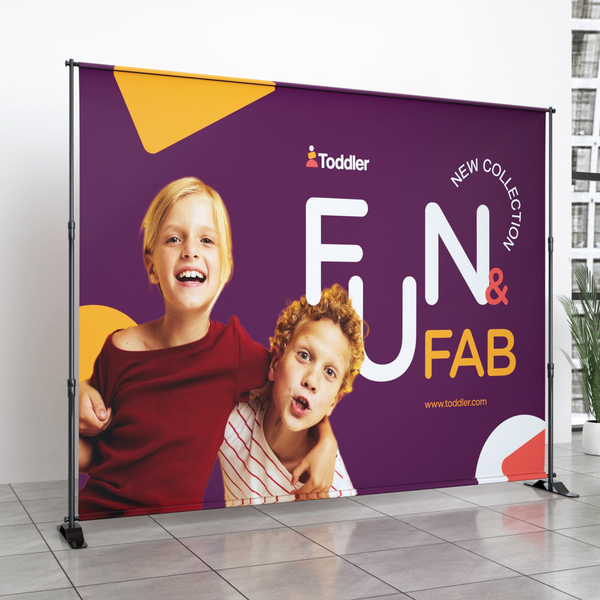
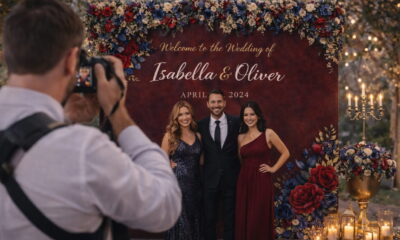
The “best” backdrop size depends on your venue, creative requirements, branding needs, the number of subjects, and the shot type (e.g., headshots, full-body shots, or group shots).
These are the standard backdrop sizes and their common applications:
- 10’ × 8’ is best for trade show booths, group photos, and step-and-repeat banners.
- 8’ × 8’ works well for most events, trade show booths, and photo studios.
- 5’ × 8’ is ideal for individual portraits, tight spaces, and small parties and events.
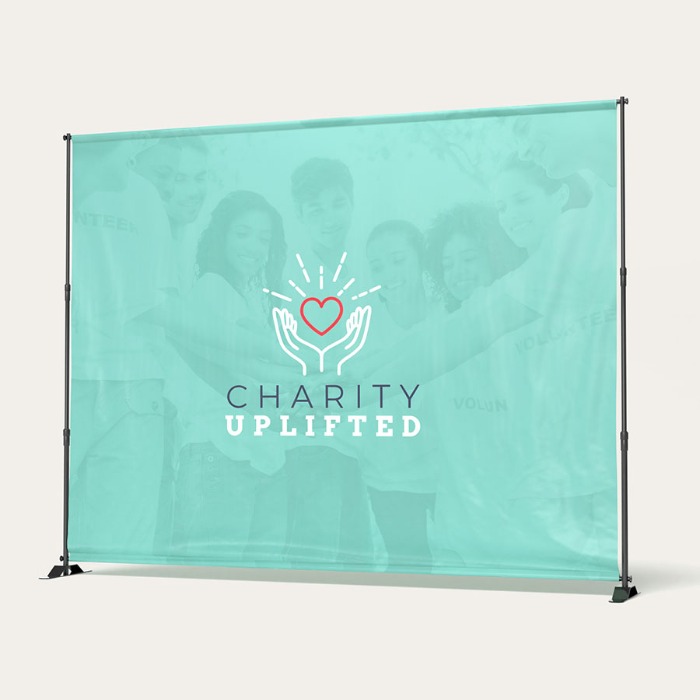
A custom printed event backdrop displayed on a stand with charity branding
These backdrop sizes are popular because they are compatible with standard frames and stands, offer photo opportunities for event attendees and guests, and fit standard tradeshow booth dimensions.
all Mounted vs. Freestanding Backdrops
How you display your backdrop, whether wall mounted or freestanding, also determines the ideal size.
The general recommendation is to choose freestanding backdrops in standard sizes because they are compatible with standard frames and stands, making them easy to set up for temporary venues and events like trade shows, galas, and parties.
Meanwhile, wall mounted backdrops are often better suited for permanent studio setups and odd spaces (e.g., walls with unusual shapes or dimensions). Thus, you may need a non-standard size that provides the right amount of coverage or meets your unique creative requirements.
Tip: Whether you use backdrops for photography studios, temporary venues, or events, the safest option is to choose a size with a vertical measurement of at least 8 ft. to accommodate a full-body shot.
How to Choose the Right Backdrop Size
Consider these key factors when picking a size for your backdrop:
Venue: Measure its width, depth, and ceiling height. And if you plan on using a backdrop to hide distractions (like pipes, boxes, equipment, and other visual clutter), consider them as well.
Number of Subjects: An 8’ x 5’ backdrop accommodates 1-2 subjects, while 9’ x 10’ and 10’ x 20’ size options suit group photos. It’s better to have a bit of extra space than to limit your composition or cram your subjects in a tight frame.
Creative Requirements: If you need backdrops to create a specific mood for an event or performance, choose a size that meets your creative requirements. For example, extra-large backdrops create a seamless transition from the wall to the floor, and they suit photo shoots with dynamic poses and movements.
Branding Requirements: Businesses attending trade shows and conferences often choose portable, lightweight backdrops, while brands hosting or sponsoring milestone events typically invest in extra-wide backdrops.
Avoid These Common Backdrop Size Mistakes
- Choosing a size based solely on the design, while ignoring other critical factors such as the venue and the number of subjects
- Ignoring the shapes and dimensions of walls and ceilings
- Not considering the mounting method (freestanding or wall-mounted)
- Disregarding creative and branding requirements
frequently asked questions
A.
The safest vertical measurement for a backdrop is at least 8 ft. to ensure a full-body shot. Also, plan for 1-2 ft. of horizontal clearance on each side so you don’t have to cram people in a tight frame or end up with unsightly cropped edges in your photos.
A.
Definitely. A backdrop that’s too small leads to tight framing and awkward cropping and limits photographers who need to capture dynamic movements and poses.
A.
It depends. But if you often attend trade shows and frequently change venues, 10’ × 8’ and 8’ × 8’ are generally considered safe options.
A.
If you want to reuse your backdrop, but it’s too big for your new venue, you can fold or trim its edges. You can also fold and hem the edges if your backdrop is made of fabric.
A.
If people need to stand shoulder-to-shoulder to fit in the frame, the backdrop is too small. Group shots need wider backdrops that allow for natural spacing.
A.
Yes. The general recommendation is to pick a backdrop size first before creating a design. This way, you can prevent cropping issues, incorrect element promotions, and distortion. Once you select a size, use a template with bleeds and margins to ensure a high-quality print without unwanted white edges.
Final Takeaway
The “best” backdrop size suits the venue, the number of subjects, and your specific needs, such as portability and ease of setup. It also hides distractions and creates a professional background for your events and photo ops.
The general recommendation is to use standard backdrop sizes because they are cost-effective to print and compatible with standard frames and sizes. But in certain situations, custom sizes might be a better option, especially if you have unique requirements, or your venue has oddly shaped walls or an unusual ceiling height.